
Coverage, Confidence, and Cost: Home and Auto Insurance in Canada



A house fire. A car accident. A quarter of Canadians aren’t sure their insurance will step in when it actually matters, creating a gap in trust and understanding. PolicyMe, in partnership with Angus Reid, set out to measure how many Canadians have home and auto insurance, how they’ve responded to economic conditions in the past year, and how confident and knowledgeable they feel about their coverage.
The findings show that while home and auto coverage rates look strong at a first glance, confidence and comprehension are trailing behind. Over 1 in 10 Canadians don’t really understand what their policy covers (13%), even as rising costs motivate them to reduce coverage, often without a clear picture of what they’re giving up.
Given that Ontario drivers can now opt out of standard auto insurance benefits to lower their insurance premiums as of July 1, 2026, it’s a concerning trend. This increased flexibility is projected to save only around $8 per month, but it only works in your favour if you know what you're opting out of.
Coverage gaps are widest among younger Canadians
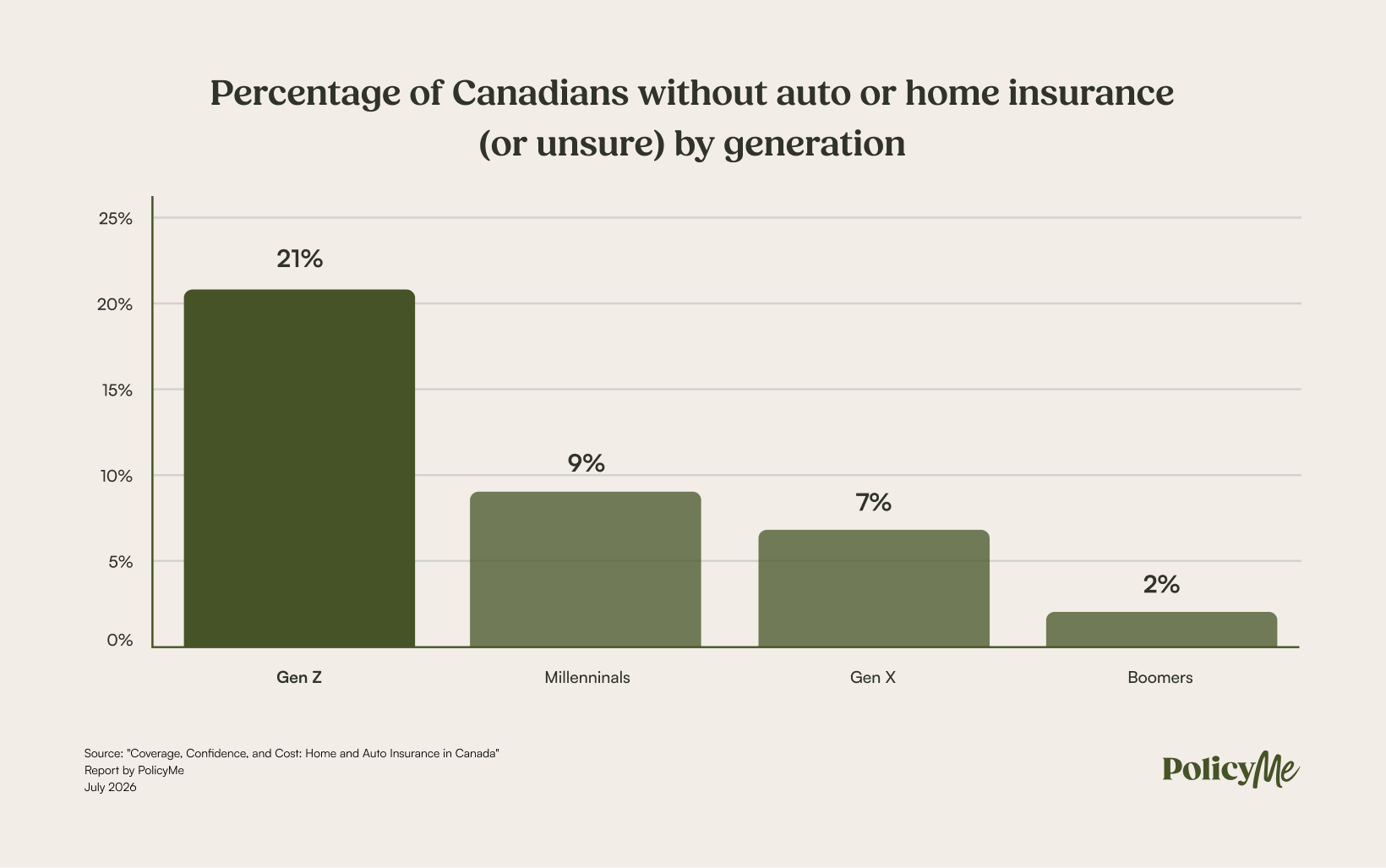
Nationally, 91% of surveyed Canadian adults have either home or auto insurance, and 70% have both, but these figures mask a generational split: 21% of Gen Z have neither type of insurance, more than double Millennials (9%), and far above Gen X (7%) and Boomers (2%). Gen Z and Millennials are also most likely to carry auto insurance without home coverage (33% and 19% respectively vs. 7% of Boomers), likely reflecting the increased accessibility of renting compared to owning a home in Canada.
It also conceals a regional divide: against a national home and auto coverage rate of 91%, Ontario trails at 87%, the lowest of any province. Of the survey respondents living in Ontario, 13% reported they had neither type of insurance or were unsure of the insurance coverage they had, the highest reported in any region.
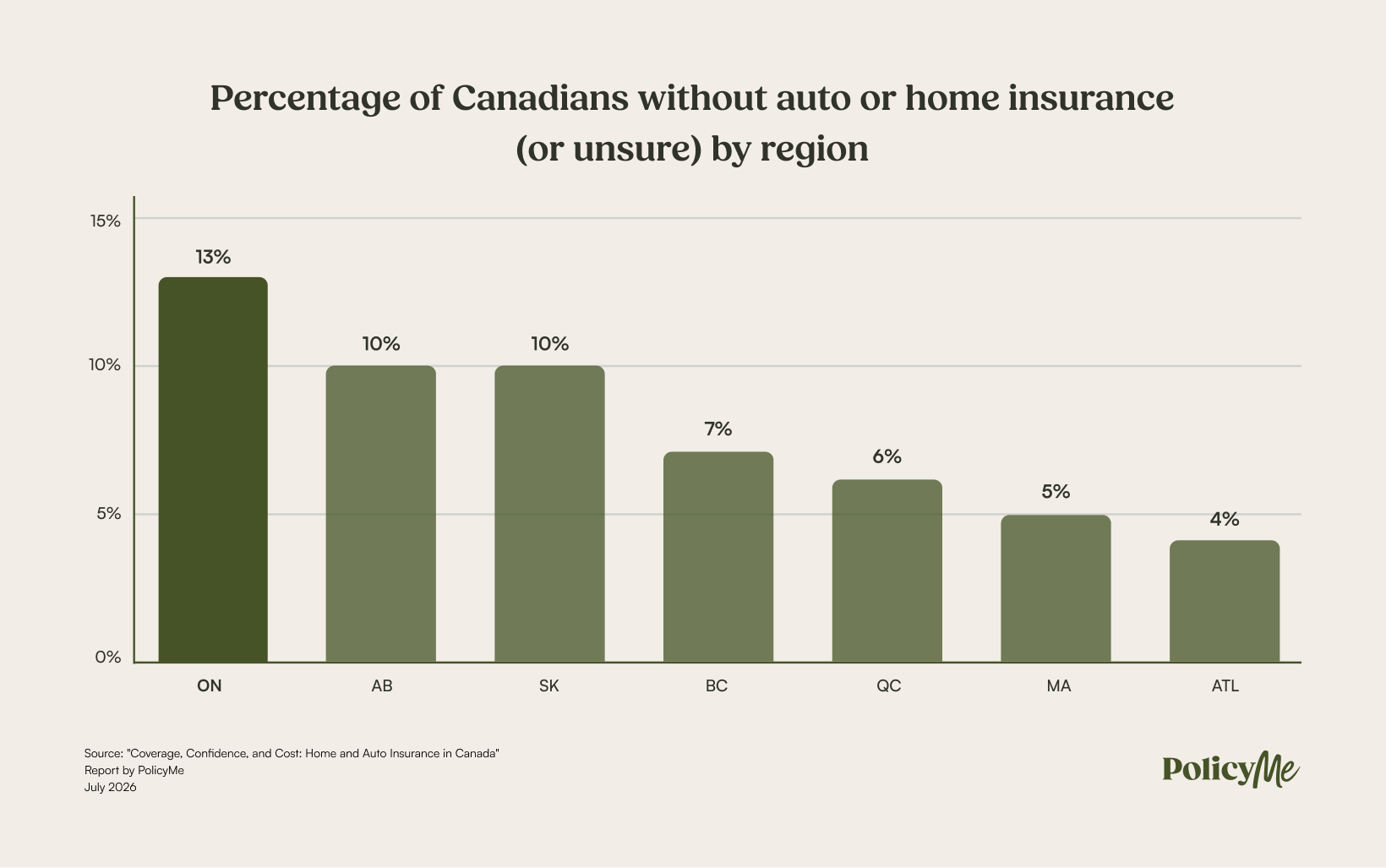

The survey conducted by Angus Reid doesn’t distinguish non-homeowners or non-car-owners from uninsured home and car owners. Ontario's lower coverage rate may reflect the province's higher cost of home and car ownership rather than underinsurance.
Ontario unprepared for auto insurance reform
As of July 1, 2026, certain auto insurance benefits in Ontario (including income replacement, caregiver and funeral costs and housekeeping coverage) are now optional. For drivers who already have coverage through their workplace or other insurance, opting out can be a cost-efficient choice.
But the data suggests many Ontario drivers won’t be making their decision with a clear understanding of what’s covered by their insurance or how reliable it is. Ontario respondents rank last or near-last on almost every measure of insurance confidence and knowledge:
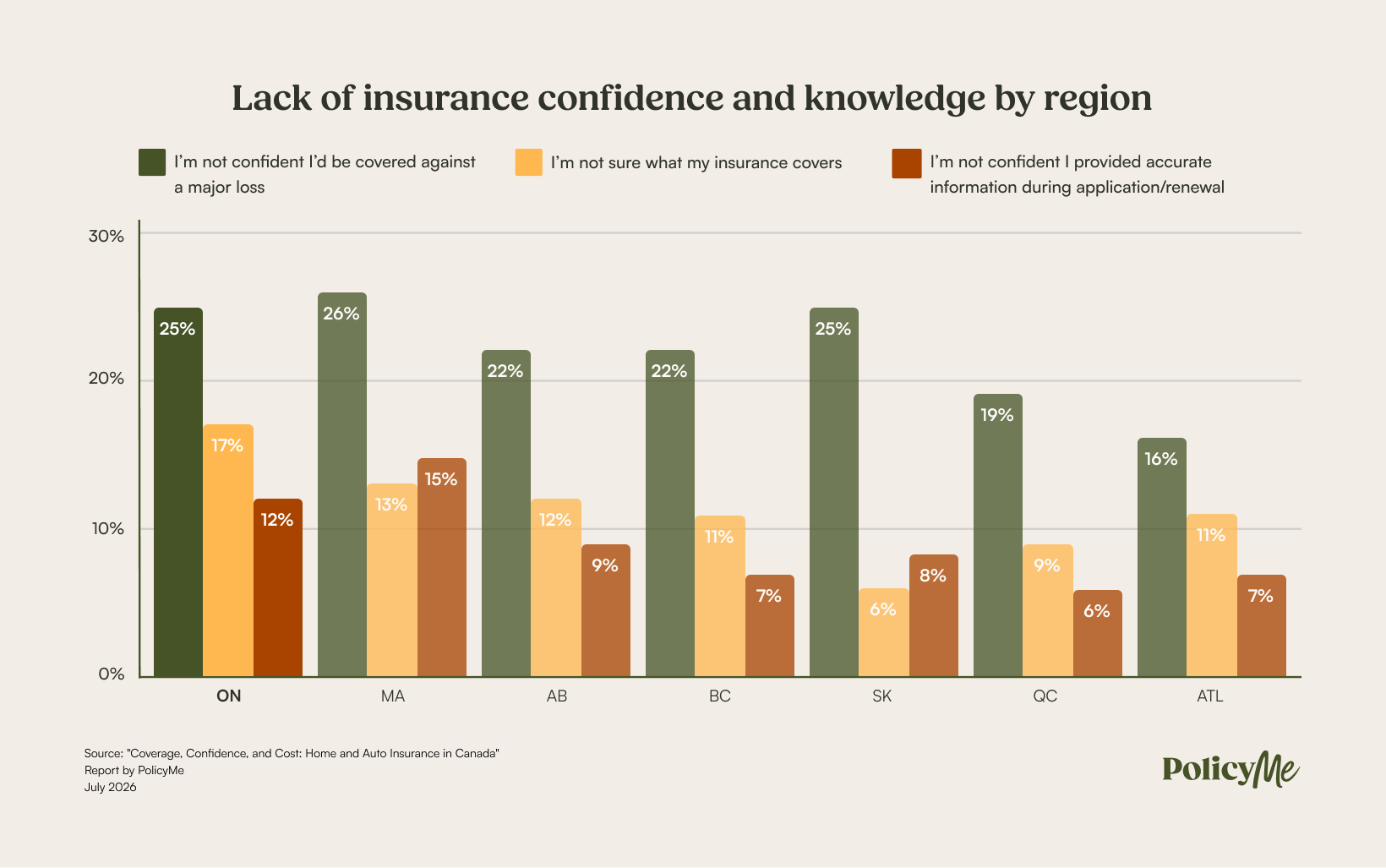
- 25% of Ontarians aren't confident they'd be fully covered in a major loss, tied with Saskatchewan for the second-highest.
- 17% of Ontarians don't know what their policy actually covers, the highest of any province.
- 12% of Ontarians aren’t confident they provided accurate information the last time they applied for or renewed their insurance policy, the second-highest of any province (behind Manitoba).
Without a clear understanding of optional accident benefits and what they cover, Ontarians are likely to be left unprotected and unprepared for the financial fallout of a car accident.
"Removing benefits like income replacement or caregiver coverage might save a driver around $8 a month,” says Andrew Ostro, CEO and Co-Founder of PolicyMe. “It’s not much when you weigh it against the cost of replacing your income for a few months, getting childcare, or arranging a funeral after a serious car accident.”
In other words, drivers should think carefully before they opt out of accident benefits. “If you’re not sure you have comparable coverage elsewhere, the safer assumption is that you probably don’t,” warns Ostro.
Nationally, 9% of policyholders aren’t confident their home and/or auto insurance policy is up-to-date, whether it’s due to recent renovations, a new roof, or a vehicle modification.
Details matter: providing inaccurate information during an insurance application or renewal can lead to slower claims, unexpected denials, or coverage gaps that are discovered too late.
Confidence to navigate insurance options builds with experience
Among survey respondents, it’s clear that confidence and knowledge concerning insurance come with age and lived experience. Gen Z and Millennials (two generations encompassing Canadians 45 and under) show especially low confidence in and knowledge of insurance:
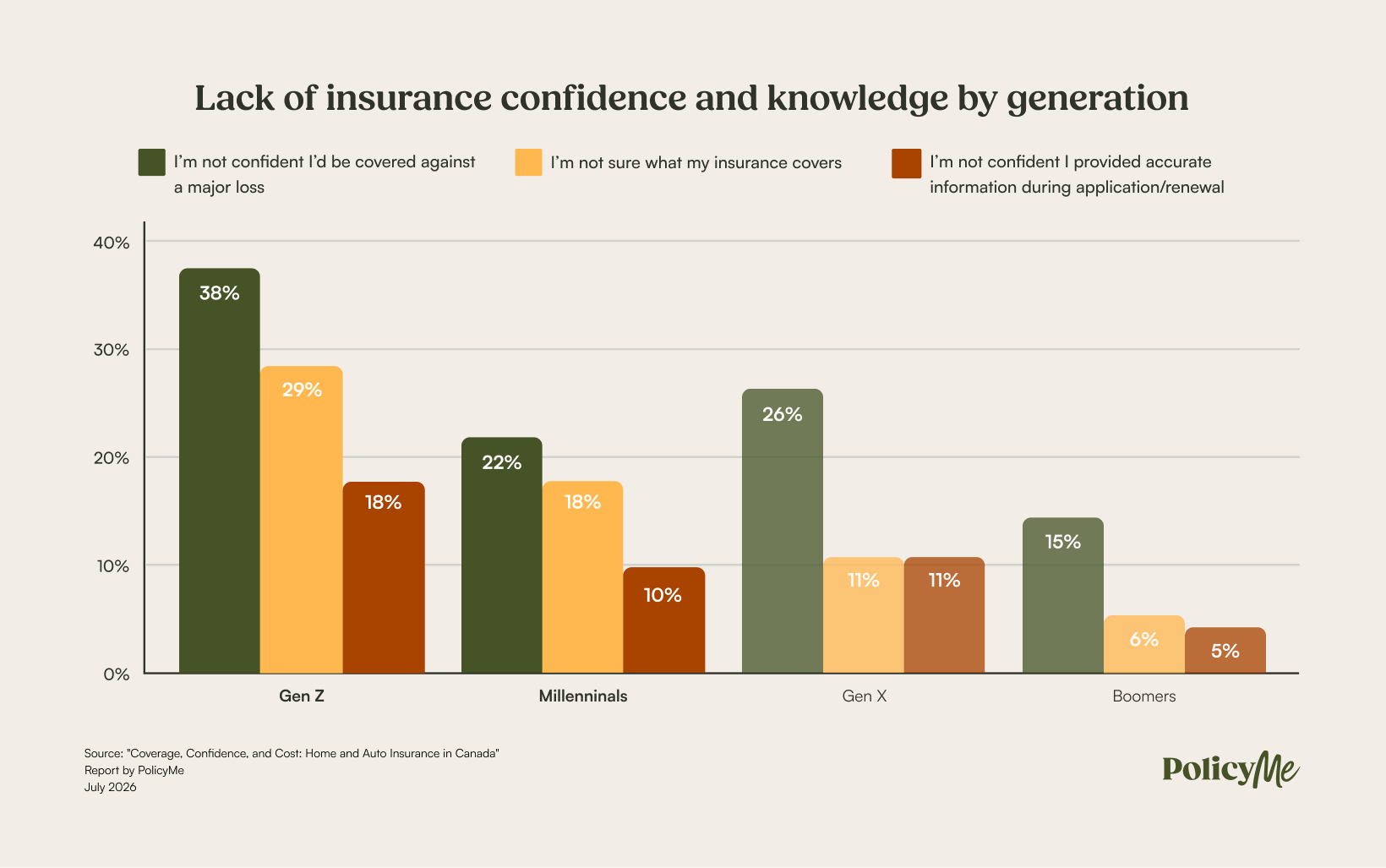
- 38% of Gen Z, 22% of Millennials, and 26% of Gen X respondents aren’t confident their insurance policy would cover them in the event of a major loss (such as fire, flood, or total vehicle write-off) compared to 15% of Boomers.
- 29% of Gen Z and 18% of Millennials admitted to not knowing what their insurance policy covers, compared to 6% of Boomers.
- 18% of Gen Z aren't confident they provided accurate information during their insurance application or renewal, compared to 5% of Boomers.
In Ontario, these trends raise concerns that drivers 45 and under will likely underestimate their need for coverage. Younger drivers also tend to have fewer savings and assets, making them especially ill-equipped to deal with the financial burden of a serious car accident.
Nationally, only 23% of Canadians are "very confident" their insurance would fully cover them (fire, flood, total vehicle write-off); 52% are only "somewhat," and one in four (25%) are not confident or unsure. Just 26% say they know their coverage "in detail," while 60% only "somewhat" know what's covered.
Finally, 49% of surveyed Canadians are “very” confident the information they gave their insurer at their last renewal was accurate, followed by 39% who feel “somewhat” confident.
When cost pressure drives coverage decisions
Given the widespread lack of understanding of and trust in insurance, it’s perhaps unsurprising that many Canadians opt to drop coverage to save money.
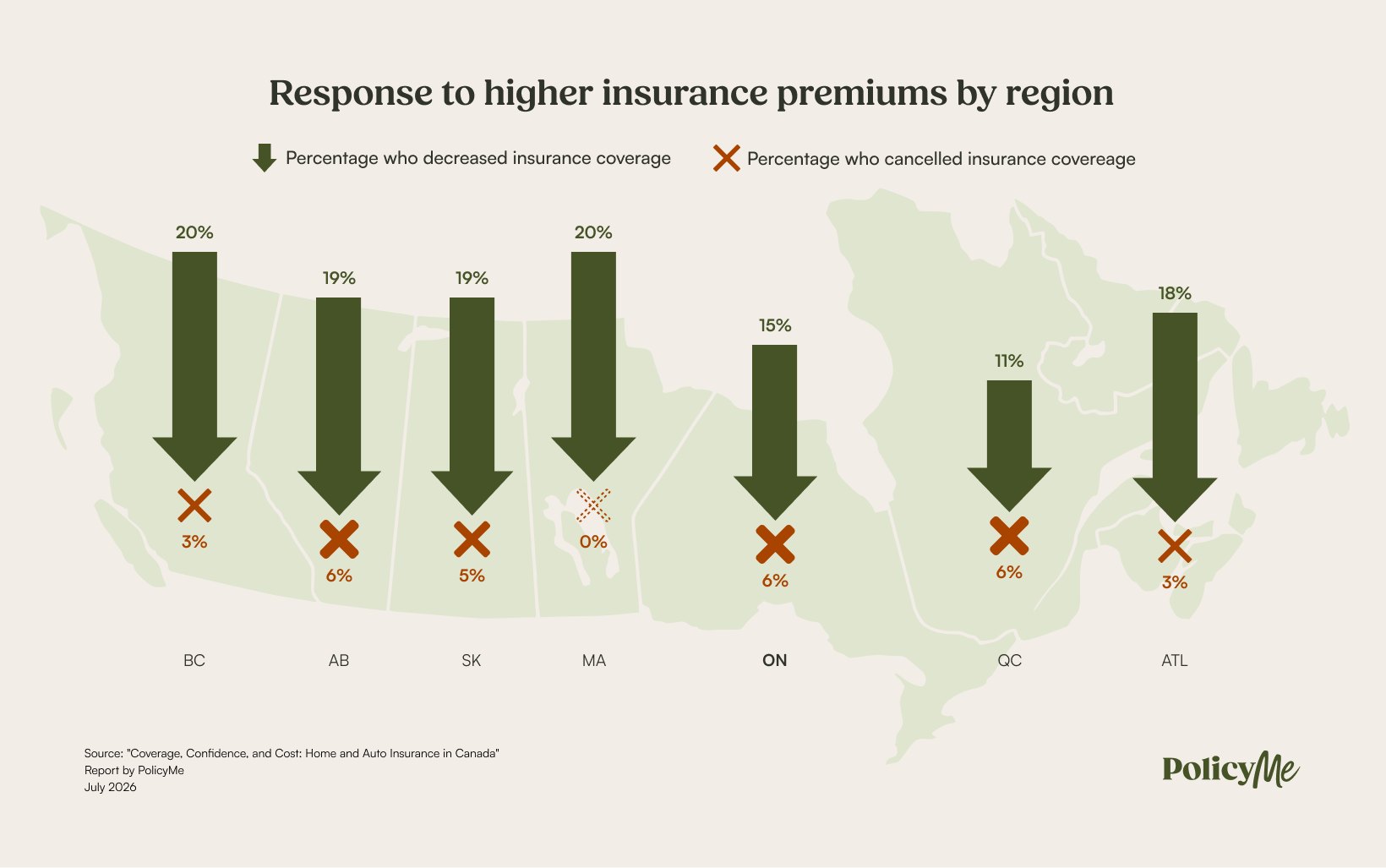
In response to higher insurance premiums, 16% of Canadians reported decreasing their insurance coverage, and 5% reported cancelling it. British Columbia and Manitoba show the sharpest pullback, with 20% of respondents in both provinces decreasing coverage due to rising premiums.
Additionally, rising household expenses such as gas, groceries, and shelter costs motivated 13% of surveyed Canadians to decrease insurance coverage and 1% to cancel it. Changes in household income or employment led 10% of Canadians to report they had decreased their insurance coverage, and 2% to cancel it.
The pattern is sharpest among Canadians 45 and under.
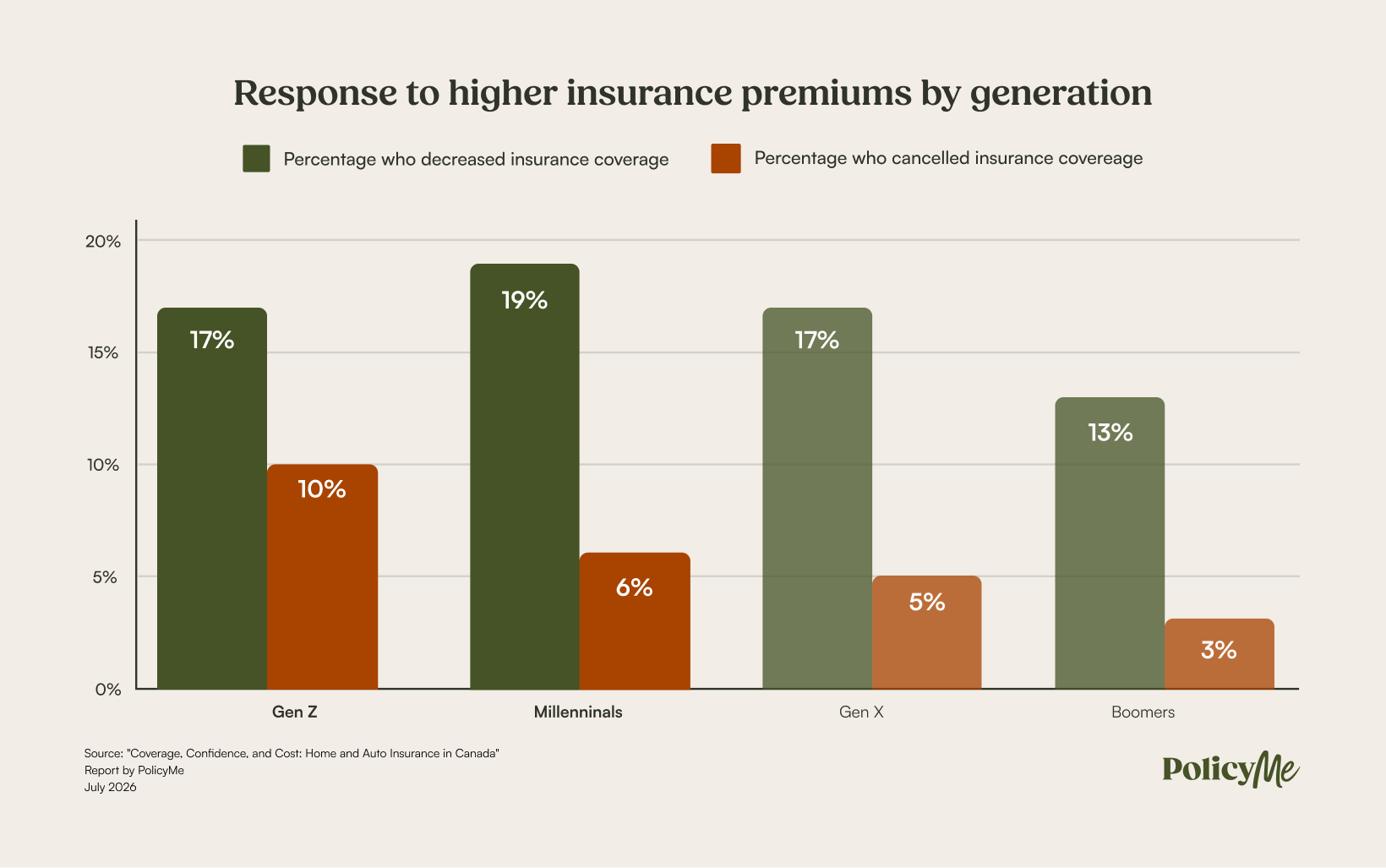
- 19% of Millennials said they had decreased coverage and 10% of Gen Z said they had cancelled it in response to higher insurance premiums (compared to 13% and 3% of Boomers)
- 17% of Gen Z and 16% of Millennials said they had decreased insurance coverage, while 4% and 1% (respectively) said they had cancelled it in response to rising household expenses (compared to 10% and 2% of Boomers)
- 13% of Gen Z and 11% each of Millennials and Gen X said they had decreased insurance coverage, while 4% and 2% each (respectively) said they had cancelled it in response to changes in household income or employment (compared to 8% and 1% of Boomers)
Returning to Ontario, these survey results suggest many drivers, particularly those managing tighter budgets, will opt out of optional car accident benefits without fully weighing the trade-off. Choosing price over protection, especially without a clear understanding of what's being given up, can leave drivers far less covered than they expect when they need it most.
Bottom line: Seek coverage clarity over cost cutting
In summary, although most Canadians carry some form of home or auto insurance coverage, a significant portion don’t know what their coverage entails or trust it to step in when it matters.
Canadians 45 and under show the largest gap between rates of coverage and comprehension as well as the most sensitivity to economic pressures, which could leave them vulnerable to costly accidents. Now that Ontario drivers are able to customize their car insurance policies to a greater degree than ever before, it’s crucial for policyholders to understand what their coverage does and whether they can afford to give it up.
PolicyMe’s new home and auto insurance can help close the gap with transparent coverage for modern Canadian families. From plain-language explanations to phone support from licensed insurance advisors, we make it easy to shop for a policy you understand, inside and out.
This article is for general information only and is not insurance or legal advice. Examples and any sample quotes or rate ranges are illustrative and do not constitute an offer or guarantee of coverage, price, or eligibility. Actual coverage, discounts, and premiums depend on your individual circumstances and the insurer provider; if there is any discrepancy, your policy and insurer documentation govern. For advice about your situation, speak with one of our licensed insurance professionals.