

Is Life Insurance Worth It? (Guide for Canadians)



Is life insurance worth it?
Life insurance can be worth it if you have loved ones who rely on you financially and may struggle to pay bills or maintain their lifestyle in your absence. A tax-free payout after your death can be a major help to your beneficiaries with any loose ends your passing might cut short, like paying off shared bills and raising kids.
Life insurance is worth it in Canada for people who have:
- Large debts, like a mortgage balance, a business loan, or significant credit card debt
- Loved ones (kids or spouse) who depend on their income and would financially struggle without it
- Financial goals that would be impeded by premature death
If you don’t have many projects on the go or you’ve undertaken sound financial planning, life insurance may not be as important. But different types of life insurance can still provide the means for post-life goals such as inheritances, funeral expenses, estate planning, or charitable donations.
As a rule of thumb, term life insurance is generally worthwhile for the average Canadian's financial needs.

According to the PolicyMe 2025 Life Insurance Gap Report, 1 in 4 Canadians (25%) is not confident or is unsure that their families would be financially secure if they passed away unexpectedly.
Who needs life insurance?
Life insurance can be helpful in Canada for people with dependents, shared debts, or who want to leave a guaranteed legacy and haven’t yet saved enough to do so.
Here are a few of the key demographics who may need life insurance.
Homeowners with a mortgage or co-signed debt
If you have an active mortgage, life insurance ensures that your debt won’t become an unmanageable burden to your loved ones if you pass away before it’s paid off.
Parents and single parents
For parents, life insurance is an essential financial safety net for your children. It can also help to cover childcare costs, education, and even extracurriculars after you’re gone, especially if you’re a single parent.
Stay-at-home parents and caregivers
Stay-at-home parents contribute meaningfully to the household. If their caregiving labour has a replacement cost (childcare, cleaning, etc.), then they should be insured even if they are not employed.
Early career adults
If you’re building a career that promises high earnings in the future, buying life insurance at an early stage can help you lock in low rates on major protection.
Small business owners and self-employed people
Running a business comes with ongoing costs. Life insurance can make sure they’re paid even after you’re gone. Self-employed Canadians may need more coverage than employed people who have access to group coverage.
Seniors with debts and dependents
Seniors are approaching end-of-life decisions, and a life insurance policy can help you leave behind financial support for any dependent loved ones. Life insurance can also help cover final expenses including burial or leave a legacy
Who may not need life insurance?
You generally do not need life insurance if you are young and healthy with no dependents or co-signed debts and enough savings to cover final expenses. The exception is if you anticipate taking on debts and dependents soon, so you want to lock in a low rate and future insurability now.
Some people do not need a large policy. Others do not need a policy at all. There’s a difference.
Life insurance options are flexible and can be worth it at any age. The key is to think about your responsibilities and financial situation and pick a policy that fits your needs.
Do I need life insurance?
You need life insurance if you have debts and dependents who rely on your income and your current assets could not cover them.
Here is a simple, three-point checklist to self-assess whether you actually need life insurance based on dependents, debts, and post-life goals.
- Do people depend on my income? Does anyone rely on me and my income for current or future stability, like a partner or child?
- Would my debts become someone else’s burden? Do I have a mortgage, car loan, or any other shared debts that my loved ones might struggle to pay if I died?
- Could I cover my final expenses and future goals? If I died tomorrow, do I have enough money saved to pay for funeral costs, leave an inheritance, and support my family’s future financial goals?
Start with the image below.
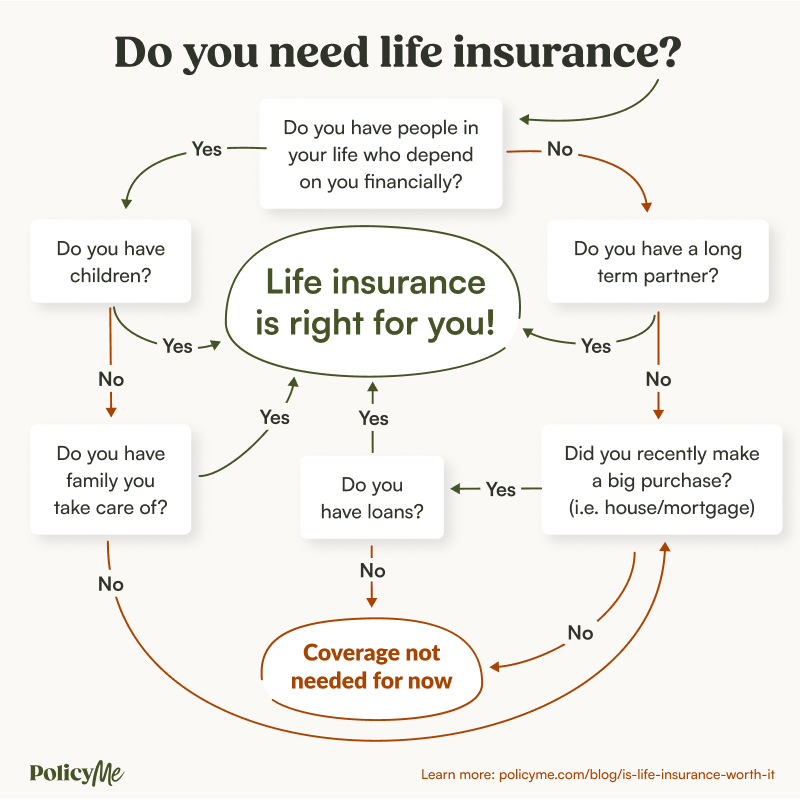
For most families, the loved ones left behind after a premature death may struggle to take care of themselves financially.
Even if you understand that life insurance is valuable, you may still wonder, is it worth it? Or rather, what kind of life insurance policy is actually worth it for me? How much coverage do I need? Do I buy now or wait?
Bottom line: Should I have life insurance?
Reflect on these questions with regard to your specific financial situation, either alone or with your partner:
- How many people rely on me financially? Don’t just think about legal dependents like children. Your partner, parents, or other family members might depend on your income in full or in part. You may expect them to become dependent in the future, too.
- What’s my total debt, and is it shared? When you die, your outstanding debts will pass to your estate. If your assets (e.g., property, savings, and investments) aren’t enough to cover them, they could pass to anyone who shared the debt, such as a spouse or a family member who co-signed a loan.
- Could my family afford a funeral right now? Death is expensive, and so is what follows. The average cost of a burial in Canada is between $5,000 and $25,000 in Canada, while cremation costs $2,000 to $5,000.
- Would someone else’s financial plans change because of my death? If a spouse, child, or elder parent is relying on you and your income, then your life insurance coverage should account for this.
- What financial goals am I saving for? If you’re saving up for major life plans, such as your children’s college education, keep in mind that your savings could be cut short if you died unexpectedly.
- Do I want to leave a legacy? You can leave your mark in other ways, but if you’d like to leave a sizable financial gift to your loved ones, a charitable cause, or another individual or organization, life insurance is a natural mechanism for that gift.
- How much room is in my budget? For most healthy, non-smoking adults aged 30-44, term life insurance premiums are well under $50/month. Many people pay far less. If you can fit that payment into your monthly budget, life insurance may be worth it.
Why term life insurance is often enough for most Canadians
Term life insurance ($20 to $30 per month) offers plenty of coverage for the average Canadian, if you match an appropriate term length to your finite financial obligations.
Couples save 10% on the first year of life insurance with PolicyMe, and all policies include $10,000 of free child coverage.
The temporary and customizable nature of life insurance is an advantage! The affordability of term policies allow your family to save more money in the long term without sacrificing protection.
- Customizable: Choose a term length that fits the length of your financial needs (5 to 40 years)
- Temporary: Coverage lasts as long as you need it and then coverage (and premiums) stop.
- Affordable: Premiums start between $20 to $30/month for $500,000 in coverage.
- Balanced: Low cost coverage now means you can invest more in long-term wealth growth.
Monthly costs are worth it
On a month-to-month basis, the cost of term life insurance is affordable and provides good value for the size of the payout.
Here’s how much a 35-year-old might pay for a 30-year term policy in Canada:
- $13/month: $100,000
- $40/month: $500,000
- $73/month: $1,000,000
Here are sample starting term life insurance costs from PolicyMe for a healthy applicant with $500,000 in coverage:
*Rates current as of August 2026
The more coverage you want, the longer the term, and the older you are, the more you’ll pay. 20-year term coverage is the most common length in Canada, as it aligns with child-rearing years and mortgage timelines.
Long-term costs are worth it
Over the entire term length, the cost of term life insurance is advantageous because you lock in a low premium when you buy the policy.
In the long run, the affordability of term coverage actually makes it the best type of life insurance. Yes, you pay premiums for 20 or 30 years but the premiums are low and then premiums will stop. In other words, you can save more.
Why permanent life insurance isn’t worth it for most people
The higher premiums of permanent policies make it difficult to invest for the future, and this is a major reason why permanent coverage is not worth it for most Canadians.
Permanent life insurance ($260 to $340/month) includes whole life insurance and universal life insurance:
- Lifelong coverage
- Guaranteed payout for your loved ones
- Premiums are very high
- You pay those premiums forever
Here are sample starting premiums for permanent whole life coverage at $500,000 for a healthy 35-year-old applicant:
*Rates current as of August 2026
“Many Canadians seem to believe they need permanent life insurance, but the reality is that permanent life insurance is a very specialized product that only meets the needs of a small percentage of the population.” — Andrew Ostro, Co-Founder & CEO of PolicyMe
Lifelong coverage: It sounds nice, but you probably do not need life insurance forever. Once your major debts are paid off, you’ve saved for retirement, and your dependents are no longer relying on you financially, that money could be better allocated.
Guaranteed payout: A big payment for your loved ones is a nice gift, but there are smarter ways to leave an inheritance. Permanent life insurance policies do include investment features that offer tax-advantaged growth. However, traditional savings and investment options have much higher growth rates than permanent policies.
High premiums for life: You do not get back all the money you put into cash value policies. While you can borrow against these policies, these are loans you have to repay otherwise they eat into your death benefit. Plus, insurance companies keep the accumulated cash value when you die and your loved ones only receive the lump-sum payout.
Most Canadian households simply cannot afford to pay for permanent coverage and invest for the future. It’s usually a better move to buy term coverage and then invest the rest in higher-growth options like TFSAs and RRSPs.
“Buy term and invest the rest. Cover yourself when you need it most, and at the end of your term, you can reassess your coverage needs.” — Stephanie Roux, Life Insurance Advisor
If you’ve already maxed out traditional savings and investment options like TFSAs and RRSPs and want to supplement your retirement income, permanent coverage or a whole life insurance policy may be an option. But unless you have a high net worth, lifelong dependents, or complex estate planning needs, a term life insurance policy with lower premiums and targeted coverage is likely the most cost-effective life insurance option.
Not sure what type of policy you need or how much coverage to buy? PolicyMe’s free online life insurance calculator is a quick way to evaluate your life insurance needs based on your annual income, mortgage payments, retirement savings, family structure, and more.
Ask an expert: do I need life insurance?
If you’re not sure whether you need life insurance, it can help to hear from an expert. Licensed life insurance advisor Stephanie Roux shares the recommendations she made to four real-life Canadian couples and individuals facing the same question.
Elena and Feng from Burnaby, BC
Elena (31) and Feng (33) have been married for two years and hold a $500,000 mortgage together. Elena works as a financial controller, while Feng is a coordinator at a non-profit.
Is life insurance worth it for Elena and Feng?

"Elena and Feng need life insurance. If one of them were to pass, the surviving spouse would have to cover the mortgage. And without their partner's income, the other might need help with daily expenses. That's why death benefits from a life insurance policy are so critical."
Asma from Calgary, AB
Asma (33) is a business analyst who owns a condo and has a mortgage with $250,000 remaining. Although she makes all the payments herself, her mother was a co-signer.
Is life insurance worth it for Asma?
"Asma needs life insurance. She has a mortgage that needs to be paid if she passes. And because her mother has co-signed, she'd be responsible for the payments. Any other outstanding debts she has could also become her mother's responsibility. She doesn't want to burden her with these costs. That's why life insurance is important."
Laila from Regina, SK
Laila (24) is a student and only a few months away from completing her studies. To keep costs low, she attends an affordable program and lives with her working parents, who can comfortably provide for their own needs.
Is life insurance worth it for Laila?
"Laila probably doesn’t need life insurance. She has no debts or dependents."
Barb and John from Barrie, ON
Barb (58) and John (62) have grown children who just moved out. The two of them are still working to pay off their shared mortgage before retiring for good.
Is life insurance worth it for Barb and John?
"Barb and John need life insurance. They still have an outstanding balance on their mortgage. Financially, their children are just starting out and may not have the money to support the surviving parent."
Next steps: if you choose to buy life insurance or not
If you choose to buy life insurance:
- Estimate your needs
- Get a quote (20 minutes online with PolicyMe)
- Instant decision and no medical exam for most applicants
- Talk to a licensed Canadian advisor if you want help
Make sure you understand the pros and cons of term vs. whole life insurance, as well as the strengths of individual life insurance companies.
If you choose not to buy life insurance: If you decide you don’t need life insurance right now, be prepared to revisit this question after any major life changes, such as the purchase of a property or the birth of a child.
FAQ: Is life insurance worth it in Canada?
You need facts, not fluff. Our goal is to provide you with honest, trustworthy information to help you make informed decisions. While our content is created with insurance experts, it is for educational purposes only and should not be considered definitive professional financial advice. We recommend seeking the counsel of a licensed financial professional before making any decisions regarding insurance or personal finance.
Bonnie Stinson is an insurance writer and researcher in Toronto with a decade of experience producing helpful, accurate content for Canadians. They have published resources for some of Canada's most innovative and consumer-trusted companies in the health, legal, and fintech sectors.
Bonnie Stinson is an insurance writer and researcher in Toronto with a decade of experience producing helpful, accurate content for Canadians. They have published resources for some of Canada's most innovative and consumer-trusted companies in the health, legal, and fintech sectors.