PolicyMe content follows strict guidelines for editorial accuracy and integrity. Learn more about our editorial guidelines.
Thank you! Your submission has been received!
Oops! Something went wrong while submitting the form.
Key Takeaways
Term life insurance is ideal for most Canadian families who have financial obligations and dependents for 10 to 30 years.
Permanent life insurance is ideal for financial planning benefits and those anticipating future health problems.
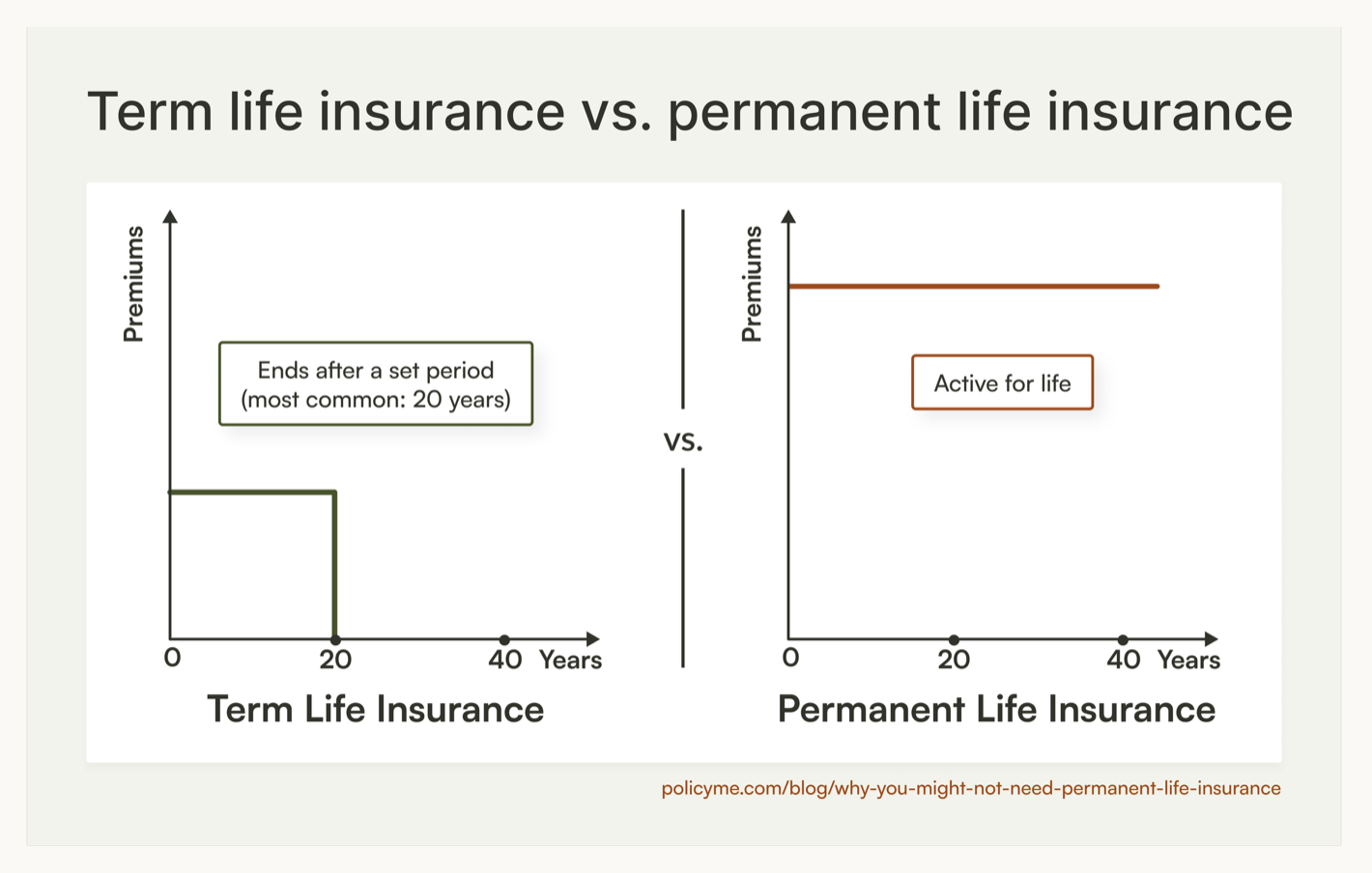
Term provides coverage for a fixed period of time, usually between 10 and 30 years, whereas permanent life insurance provides coverage for the rest of your life.
A permanent life insurance policy is usually five to 15 times more expensive than a comparable term policy.
Coverage length is the main difference between these two types of life insurance policies in Canada. Term policies last for a set period and permanent policies last until you die.
What is term life insurance?
Term life insurance covers you for a set period (pays out only if you die during the term you choose). It’s cheaper, more common, and a better fit for most Canadians.
Term policies are very popular in Canada, especially for those seeking financial protection for temporary obligations. Individual (i.e. not group) term life sales made up 40 percent of policies in Canada in 2024, more than double that of permanent policies.
What is permanent life insurance?
Permanent life insurance is lifelong (pays out whenever you die). Though appropriate for some people, it’s very expensive and you pay those premiums for life which is well past when your dependents and debts probably need you.
There are several subtypes of permanent life insurance: whole life, universal life, and term-to-100. All last for life, but the features vary.
Let's look at each policy type further.
Feature
Term Life Insurance
Permanent Life Insurance
Coverage duration
Fixed term: typically 10, 20, or 30 years
Lifelong coverage (as long as premiums are paid)
Types of policies
Typically just “term life”
Includes whole life, universal life, and term-to-100
Coverage amount
Typically $100,000 to $10 million
Varies based on plan type
Premium structure
Usually fixed for the term
Some have fixed premiums; others allow adjustments
Renewability
Some policies are renewable
Not applicable ( doesn’t expire while premiums are paid)
Convertibility
Some policies can be converted to permanent
Not applicable (policies are already permanent)
Policy expiry
Ends after the specific period unless renewed or converted
Expires only if you stop paying premiums
Cash value/investment component
No cash value
Some types include a savings/investment component (e.g. whole or universal life)
Best suited for
Parents with minor children, mortgage holders, couples, business owners
High-net-worth individuals, those with estate planning needs, or lifelong financial dependents
This quick video is a great primer:
Term vs. permanent: which one should you choose?
While most Canadians should choose term coverage, here’s a simple guide to who should get term vs. permanent:
I have a kid and a mortgage.
→ Consider term.
I have a lifelong dependent.
→ Consider permanent.
I have a family with a history of health conditions.
→ Consider getting term and converting later if needed.
Who: Paulette (45) chose a permanent life insurance policy. She has no children and wants to transfer her generational wealth responsibly.
What she’s protecting:
Inherited wealth
Properties
How permanent coverage fits:
Tax-advantaged $15M payout skips probate and goes directly to her niece and nephew (beneficiaries)
Money can help pay Paulette’s final taxes without forcing property sales
Scenario: Single person with no dependents (term or none)
Who: Martin (38) chose a term policy. He is unmarried and has some retirement savings.
What he’s protecting:
His estate
His legacy
How term coverage fits:
A $50k 25-year policy can cover Martin’s final expenses and estate taxes if he passes away early
Covers a small donation to his favorite charity
Pros and cons of term life insurance vs permanent life insurance
Life insurance is a smart choice if you have financial obligations that could become burdensome to your loved ones if you pass, but the right type of life insurance policy for you will depend on your financial needs, goals, and stage of life.
Type
Pros
Cons
Term
• Lower cost for the same coverage
• Simple and easy to understand
• Matches temporary needs (mortgage, kids)
• Option to renew or convert
• Coverage ends after the term
• Renewal costs can jump later
• No cash value or savings
Permanent
• Lifelong coverage
• Guaranteed payout (if policy stays active)
• May build cash value
• Can support estate planning
• Much higher cost than term
• More complex to manage
• Lower returns vs other investments
• Often unnecessary for short-term needs
Bottom line: Term life offers simple, affordable protection for a set number of years, while permanent life offers lifetime coverage and some financial planning advantages but at a much higher cost.
Pros
Cheaper than permanent: Premiums are typically much lower, making it accessible for families, homeowners, and young professionals.
Matches your temporary needs: Ideal for covering short-term expenses that won’t last forever, like raising children, paying off a mortgage, or replacing income until retirement.
Simple to understand: With no cash value or investment component, term policies are straightforward and easier to manage compared to whole life, universal, or term-to-100 policies.
Flexibility to convert or renew: Some policies offer the option to convert to a permanent policy or renew at the end of the term.
Cons
Coverage ends after the term: You'll need to renew or apply for a new policy if you still need insurance when your term ends, and this may lead to a higher cost due to age or health changes.
No cash value: There is no investment component for term life policies, so you won’t receive any return for this policy type—and you can’t make any withdrawals via policy loan.
Pros
Lifelong coverage: As long as you pay your premiums, your beneficiaries are guaranteed a payout, no matter when you pass away.
Helps with estate planning: Having a permanent life insurance policy could come in handy if you anticipate paying estate tax on your estate when you pass away. Unlike a mortgage, estate tax isn't an expense that you can pay off earlier in life when a term life insurance policy still covers you.
May support passing on property: A permanent policy could be purchased as a way to offset the eventual life insurance tax liability if you own a second residence and want to pass it on to the next generation.
Can cover lifelong financial responsibilities: A permanent policy may be something to consider if you know you’ll have lifelong costs, such as a child or other dependent with a disability you support, which may cause your coverage needs to stay level.
Cons
Significantly more expensive: Premiums can be five to 15 times higher than term policies for the same coverage amount.
Over-insures many Canadians: It assumes you have the same financial obligations forever. If you don't expect to have dependents like young kids, aging parents or debt (e.g. your mortgage) well into the future, why pay life insurance premiums for the rest of your life?
Lower investment returns: The cash value component typically grows slowly and may offer lower returns than other traditional investment vehicles like TFSAs or RRSPs. Plus, investments don’t have a guaranteed rate of return.
Complex to manage and understand: With multiple types (whole life, universal life, term-to-100), and varying features, these policies require more effort to maintain and optimize.
Ties up funds you could invest elsewhere: Paying higher premiums means less flexibility to build wealth through more effective avenues.
Which is cheaper? Term vs. permanent life insurance
Term life insurance is almost always cheaper than permanent life insurance, at least for healthy average Canadians.
Take a look below at the cost comparison for the various types of life insurance policies:
Policy
Premium*
Notes
T10
~$14
Cheapest, short-term needs
T20
~$19
Balance of cost and coverage
T30
~$30
Longest coverage, higher cost
Whole
$100–200
5–15x pricier, lifelong coverage
* Monthly rates are based on a 30-year-old nonsmoking woman with $500,000 of coverage from PolicyMe. Men typically pay higher rates than women. Smokers pay higher rates than non-smokers.
While life insurance costs vary from person to person, there is a consistent trend when comparing term and permanent life insurance premiums. Permanent life insurance policies are typically up to 15 times more expensive than term coverage. That’s because permanent coverage is guaranteed to pay out and may include a savings or investment component.
Note that life insurance premiums vary based on age, sex assigned at birth, smoking status, health, lifestyle, coverage amount, and policy type.
Is permanent life insurance a good investment?
Permanent life insurance offers an investment component, but this doesn’t mean it’s a good investment. It can seem like a positive feature and a good selling point, but for most people, keeping investment funds in permanent policies doesn’t offer the same flexibility and potential returns that a separate investment fund would.
On top of this, the premiums on a permanent policy are significantly higher than term policy premiums, meaning you’ll have less to invest overall. If you calculate what you’ll pay for a term life insurance policy compared to a permanent one, you’ll find the difference significant.
Next, calculate what you could earn if you invested the cost difference separately, earning interest in a traditional investment account over the next 10 or 20 years.
In most cases, a term life policy is ideal to meet your family’s coverage needs and financial goals, and you can invest the difference in a separate investment account. This way you have the freedom to control how it’s invested and earn greater returns.
How do I know which type of life insurance is best for me?
The best life insurance options will depend on your specific financial responsibilities and long-term goals.
If your needs are temporary, like covering your mortgage, replacing income while your kids are still dependent, or providing financial support for a partner until retirement, term life insurance is likely the better fit. It offers affordable coverage and is designed to match the timelines of these common life stages.
For those with lifelong needs, like supporting a dependent with a disability or managing a large estate, permanent life insurance products may be worth considering. Just keep in mind that the higher cost only makes sense when those needs are truly long-term.
Who is term life insurance good for?
Term life insurance is a practical, cost-effective way to protect your family during the years they need it most.
Here are some common examples:
Parents with young children: To replace your income and cover living expenses until your kids are financially independent.
Couples who rely on each other’s income: To help cover shared expenses while you're still working toward retirement.
Mortgage holders: To ensure your family can pay off the home if something happens to you before the mortgage is fully paid.
Business owners: To cover business debts or financial obligations if you're no longer around to manage them.
Couples nearing retirement without sufficient savings: As a safeguard while building your retirement cushion.
Those supporting elderly parents: To protect your loved ones from financial strain if you're the primary caregiver or income provider.
If you have permanent life insurance needs, like a disabled child or are an exceptionally high income earner, a whole life policy might make sense. Here are a few scenarios:
High net worth individuals ($10M+ in assets): There are tax-deferred benefits for those that have already maxed out TFSA and RRSP accounts
Canadians with complex estate planning needs: To protect the value of the estate to maximize the inheritance you pass on
People who need a forced way to save for retirement: But this should not be a standalone retirement saving strategy
FAQ: Term vs. permanent life insurance
Permanent life insurance lasts your entire life, as long as you continue to fulfil your premium payments. However, this lifelong coverage comes at a steep cost, often making these policies unnecessary for most Canadians. Unless you have long-term financial obligations, a term life policy can provide the right amount of protection at a fraction of the price.
Permanent life insurance is often seen as a poor financial choice for most Canadians because of its high cost and unnecessary complexity. Canadian who could better protect their assets with a combination of term coverage and investing/saving. Permanent coverage may build cash value and offers lifelong coverage, but premiums are 5-15x higher (and those premiums last for life, too).
The question of whether permanent life insurance is haram (forbidden) can be a bit tricky. In Islam, things like uncertainty (gharar) and gambling (maisir) are considered haram. Some argue that since traditional life insurance involves elements of these, it might be seen as haram.
However, it's important to remember that the interpretation can vary among different scholars and individuals. Some might see the concept of insurance, including permanent life insurance, as a form of mutual help and protection among the community, which is in line with the principles of Islam. To sum up, whether permanent life insurance is considered haram or not can depend on the individual's interpretation of Islamic principles. If you're unsure, it's always a good idea to seek advice from a knowledgeable person in your religious community.
Whole life insurance is one type of permanent life insurance, but permanent life insurance also includes other options like universal life and term-to-100.
Whole life is the most traditional version of permanent life insurance, with fixed premiums, guaranteed coverage, and a cash value component. Other permanent policies, like universal life, offer more flexibility but can be more complex to manage.
Yes, most permanent life insurance policies build cash value over time, which acts like a savings component within the policy. You can sometimes borrow from or withdraw this amount, but doing so may reduce your death benefit.
Keep in mind that this feature is funded by the much higher premiums you pay compared to term life insurance. For most people, investing separately is a more flexible and cost-effective option.
If your term policy is convertible, yes, you can switch from term to permanent coverage with the same company. There are important rules to follow, however. You must switch within the eligibility window (usually by a certain age or prior to policy expiration date). Apply, get the new premium, and enjoy your new policy.
For most Canadians, term is better than permanent life insurance because it’s more affordable and it aligns with their major financial obligations (which are temporary, not permanent). Permanent may be better if you have a lifelong dependent or if you’re high-net-worth and looking for tax advantages.
There are three types of permanent life insurance: whole life, universal life, and term-to-100. All provide lifelong coverage. Whole life and universal life are cash value policies, whereas term-to-100 has no cash value. Whole life has fixed premiums and the company manages your investments. Universal life is more flexible but also riskier because you manage your own investments.
Yes, you can cash out permanent life insurance policies once they’ve accumulated enough cash value. It usually takes around five years, because the first few years of your payments are heavily weighted toward admin and insurance coverage. “Cash out” can either mean that you borrow money from your own policy, which must be repaid, or it can mean that you partially or fully surrender your policy and withdraw the cash value.
If your policy is convertible (and many in Canada are), then you can convert term life insurance to permanent coverage. Many policies have a time limit, like within the first 5 years of the policy or before a certain age. When you convert, you’ll be given a new higher premium in exchange for lifelong coverage with no medical exam necessary.
Bonnie Stinson
Bonnie Stinson is an insurance writer and researcher in Toronto with a decade of experience producing helpful, accurate content for Canadians. They have published resources for some of Canada's most innovative and consumer-trusted companies in the health, legal, and fintech sectors.
Bonnie Stinson is an insurance writer and researcher in Toronto with a decade of experience producing helpful, accurate content for Canadians. They have published resources for some of Canada's most innovative and consumer-trusted companies in the health, legal, and fintech sectors.