

Best Critical Illness Insurance in 2026 (Canada)


What is critical illness insurance?
Critical illness insurance in Canada provides a tax-free lump-sum payout if you're diagnosed with a serious medical condition covered by the policy. Investing in critical illness insurance might be worth it if your loved ones would struggle financially due to a serious illness that prevents you from working.
Critical illness insurance payouts can be used for things like:
- Paying your bills while you're off work
- Covering treatment costs and other medical expenses
- Providing childcare or home care
- Supplementing your income
Each critical illness plan covers different medical issues. Stroke, heart attack, cancer and organ failure are covered by most (but not all!) critical illness insurance policies in Canada.
There are exclusions that apply to critical illness insurance coverage. For example, a previous cancer diagnosis or other pre-existing condition may affect your eligibility. Rules vary by insurer.
What is the best critical illness insurance in Canada in 2026?
PolicyMe takes the top spot among critical illness insurance providers in Canada due to high rankings across the categories that make a good critical illness policy:
- Benefit amount that delivers real financial protection
- Comprehensive list of conditions you’re protected against
- Affordable premiums (even more so if you combine with life insurance)
- Easy application process
Many major insurance companies offer critical care insurance products. Let’s take a look at some of the biggest names in Canada and compare their offers and covered conditions:
PolicyMe critical illness insurance
PolicyMe offers the most extensive critical illness coverage in Canada, covering 44 illnesses and conditions. Most other leading competitors in the space cover 34 or fewer. You can apply for term life and a critical illness insurance quote at the same time and receive an instant decision.
Flexible coverage options include:
- $10,000 to $1M in coverage
- 10- to 30-year term lengths (similar to PolicyMe term life insurance)
- 44 covered illnesses, including more cardiovascular and cancer conditions covered than any other Canadian insurer
- No 30-day waiting period; you can submit a claim for 24 of 44 conditions after diagnosis
Sun Life critical illness insurance
Sun Life offers two types of critical care insurance plans in Canada. The less comprehensive coverage policy is called Express Critical Illness, and the more comprehensive policy is called Sun Critical Illness. You may need to speak to a Sun Life insurance advisor to learn more or apply.
- $25,000 to $3M in coverage for adults ($1M limit for child plans)
- 10-year renewable term, 75-year term, or lifetime
- 26 illnesses covered for full payout protection
- 8 less-severe illnesses covered for partial payout protection
Manulife critical illness insurance
Manulife offers three critical illness insurance plans, though the most basic critical illness benefit only covers five major illnesses. CoverMe offers online quotes, but you’ll need to speak to a Manulife advisor if you’re interested in a Lifecheque critical illness insurance quote.
Lifecheque Basic:
- $25,000 to $75,000 in coverage (limit is $50,000 for ages 56–60 and $25,000 for ages 61–65)
- 5 severe illnesses covered for full payout protection
- Optional add-on: Get eligible premiums back at age 75 if you never make a claim
Lifecheque:
- 24 critical illnesses covered for full payout protection
- 6 early intervention conditions covered for partial payout protection
- Monthly Care Benefit if you meet the criteria for functional dependence
- Optional add-on: Get eligible premiums back if you die without filing a claim
CoverMe:
- $25,000, $50,000, or $75,000 in coverage
- 5 severe illnesses covered for full payout protection
- Policy covers you until age 75, even if your health or occupation changes
BMO critical illness insurance
BMO offers two types of typical critical illness coverage: a term plan or a permanent plan with 25 covered conditions plus seven early-discovery conditions. You can also get CII as an add-on to a BMO life insurance policy.
BMO's term plan:
- $25,000 to $2M in coverage
- 10- or 20-year terms, renewable to age 75
- Convertible to a permanent Living Benefit 75 or 100 policy
BMO's permanent plan:
- Coverage to age 75 or 100
- Premiums guaranteed never to increase
How we ranked the best critical illness insurance
The companies on this list were compared across key criteria like affordability, customer reviews and industry reputation, policy options, and application process.
Affordability: We compared prices for the same type of applicant to get a fair baseline. We observed a $13/mo difference between the most affordable policy (Manulife) and the most expensive (Sun Life).
Customer reviews and industry reputation: We studied online content to understand which brands are trusted by real policyholders. Bank-owned providers (BMO) tend to have a longer-established brand, but digital-first operators like PolicyMe earn better customer reviews across platforms like Google, InsurEye, and Reviews.io.
Policy options: We assessed each provider’s number of covered illnesses, range of payout options, and the flexibility of its policy configuration (term length, convertibility, renewability, and additional features like waiver of premiums and return of premium).
Application process: We evaluated how easy it is to get a quote and purchase a policy from each provider. Some require you to speak on the phone with an advisor, whereas others allow you to apply completely online.
Ultimately, no company wins in every category. Our unbiased ranking of critical illness insurance options is intended to help consumers select the combination that works best for their needs.
- PolicyMe: Most conditions covered, great customer reviews
- Sun Life: Most expensive, high industry reputation
- Manulife: Most affordable, but fewest conditions covered
- BMO: Second-highest payout cap, second-most expensive
How critical illness insurance works in Canada
Critical illness insurance pays out a cash benefit while you’re alive if you get diagnosed with a covered critical illness listed in the policy. This money can be used for anything you want, but you must have purchased the policy before your diagnosis.
The major benefit: There are no restrictions on how you can use your critical illness insurance payout.
A critical illness insurance payout is a tax-free lump sum with no strings attached. Once it’s in your bank account, you can use this money for anything you need, from covering mortgage payments and everyday living costs to paying for out-of-pocket medical care or home modifications to support your recovery.

Gina files a critical illness life insurance claim with PolicyMe on the day of her diagnosis. Since her illness qualifies under PolicyMe’s 24 fully covered conditions, she receives her full critical illness payout with no waiting period or survival period. Gina uses the payout to replace lost income and cover household expenses while she recovers.
How a claim is triggered
Here’s a step-by-step overview of how critical illness insurance payouts work in Canada, starting with the condition that triggers your claim eligibility:
- Step 1: Get diagnosed with a covered condition: If your policy lists the condition, then your diagnosis allows you to begin the claims process.
- Step 2: Survive the waiting period (if applicable): This is an eligibility criteria in most policies. The waiting or elimination period is usually 30 days in Canada, though it depends on the illness and the provider*. You can only file for a payout once you survive this period after your diagnosis.
- Step 3: Wait for the critical illness insurance payout: The timeline is 7–10 days on average to receive the tax-free lump sum payment after a critical illness claim is approved.
Some insurers, like PolicyMe, have no waiting period for certain serious conditions and you’re eligible for full benefit payouts with no waiting period for 24 of 44 conditions.
Gina files a critical illness life insurance claim with PolicyMe on the day of her diagnosis. Since her illness qualifies under PolicyMe’s 24 fully covered conditions, she receives her full critical illness payout with no waiting period or survival period. Gina uses the payout to replace lost income and cover household expenses while she recovers.
What illnesses are covered by critical illness insurance?
Critical illness insurance typically covers serious medical conditions such as cancer, heart attack, stroke, organ failure, and multiple sclerosis. Each insurance provider has its own list of covered conditions and eligibility requirements, and there may be variability based on the type of policy.
For example, PolicyMe’s critical illness insurance covers 44 conditions, including 27 fully covered conditions and 17 early-stage conditions.
Here’s a quick summary of the conditions covered by PolicyMe’s critical illness insurance:
- Cancer: Several types and stages of cancer, including some early-stage cancers and qualifying life-threatening cancers.
- Heart conditions: Heart attack, coronary artery bypass surgery, heart valve replacement or repair, aortic surgery, and cardiomyopathy.
- Neurological conditions: Stroke, multiple sclerosis, Parkinson’s disease, ALS, dementia, coma, paralysis and acquired brain injury.
- Autoimmune conditions: Aplastic anaemia, occupational HIV infection and multiple sclerosis.
- Sensory and mobility conditions: Blindness, deafness, loss of limbs, loss of speech, severe burns and loss of independent existence.
- Transplant and organ-related conditions: Kidney failure, organ transplant, organ failure while on a waiting list and cardiovascular procedures.
- Early-stage conditions: Select early-stage cancers and cardiovascular conditions that qualify for partial benefits.
Note that having a pre-existing condition doesn’t automatically disqualify you from getting critical illness insurance, but it may affect your eligibility, premium or whether that condition is covered.
In more detail, here is a full list of the conditions covered by PolicyMe’s critical illness insurance:
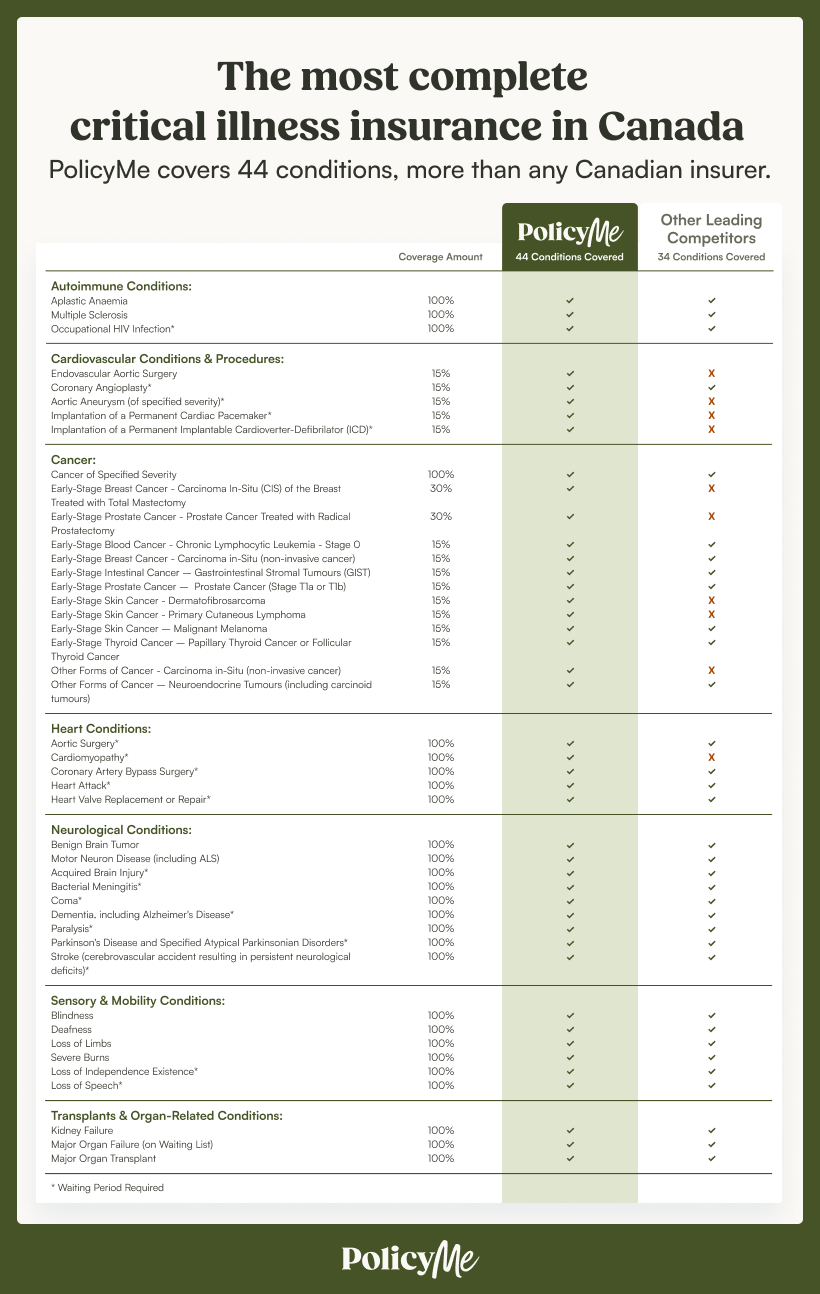
Critical illness insurance doesn’t cover every illness or diagnosis, and coverage depends on the policy’s medical definitions. Claims for conditions that aren’t listed on the policy or don’t meet the eligibility requirements won’t qualify for a payout, and some policies may exclude certain pre-existing conditions. Illnesses diagnosed before coverage begins are typically ineligible. Some conditions trigger partial payouts, such as angioplasty and prostate cancer.
Who needs critical illness insurance in 2026?
Imagine you become seriously ill and are unable to work for months. Your income would decrease, and your expenses would increase. If this situation would put financial strain on you and your family, you may want to consider critical illness insurance.
Some insurance providers also offer child critical illness coverage, which can help families manage expenses if a child is diagnosed with a covered illness.
How much does critical illness insurance cost in Canada?
The average cost of critical illness insurance in Canada in 2026 is around $35 per month for $100,000 of coverage for a 30-year-old on average.
Here’s an overview of the average cost of critical illness insurance for non-smoking men and women with a 20-year term and $100,000 in coverage.
*The insurance rates above are based on publicly available critical illness insurance quotes for non-smoking applicant, with $100,000 in coverage for a 20-year term as of September 2026.
How much critical illness insurance do you need?
The exact number depends on your financial situation, but you need enough critical illness insurance to cover your daily living expenses plus additional healthcare costs while you’re ill and in recovery.
Basic critical illness insurance policies start around $25,000, and the average policy in Canada provides a payout between $50,000 and $100,000. Some policy limits are as high as $2 million, but this comes with very high monthly premiums.
Start here: Add up three months of mortgage or rent, three months of replacing lost income, and estimate potential out-of-pocket care like hospital parking, specialty drugs, and assistive tools or paramedical care.
$50,000 - $100,000: A single person who has some savings, moderate living expenses, and a manageable rent payment could use $100,000 to cover several months of lost income and out-of-pocket care costs while recovering from a serious illness.
$200,000 - $500,000: More coverage might be necessary for a higher-income family with children. A $500,000 payout could replace income and cover higher expenses for six months, absorbing the financial shock of losing the primary breadwinner or the stay-at-home parent’s labour.
Calculate your own number for free. Get a critical illness insurance quote to model the payout your family would need to stay afloat if you became seriously ill.
Is critical illness insurance worth it?
Critical illness insurance is a smart purchase in 2026 if you (and your family) would face immediate financial pressure if you become seriously ill. Although it may not seem necessary for everyone, critical illness insurance is worth considering based on your finances and risk tolerance.
For example, according to the Canadian Cancer Society, an estimated 42% of Canadians will be diagnosed with cancer in their lifetime, making it one of the country’s most common serious illnesses. While nobody expects a diagnosis like cancer, it’s important to consider how you would manage the financial impact of treatment, time off work, and covering expenses such as childcare or household bills.
Critical illness insurance is designed to provide an influx of cash to support critically ill people as they deal with their condition.
One approach is to secure critical care insurance for the time in your life when a major diagnosis would hit your finances the hardest—the years when you’re paying down a mortgage or raising kids, for example.
“To keep premiums low and still get meaningful protection, buy the amount of coverage your family would truly need for things like the mortgage, education, and living costs. Apply early while you’re young and healthy, since that’s when rates are lowest and you can lock them in for your full term.” – Jeremy Burbano, Insurance Advisor
If you already have a strong emergency fund, a gainfully employed spouse, and excellent workplace benefits, then you probably don’t need critical illness insurance.
Bottom line: Critical illness insurance is worth considering to help protect your income, savings and long-term financial goals if a serious diagnosis would put financial stress on you or your family.
How to get the best critical illness insurance for you
To find the right critical illness policy for your situation, ask yourself these questions:
1. For which conditions and illnesses do I want coverage?
- If certain conditions run in your family, start with these.
- If you don’t know, look for a company that covers a long list of diseases.
2. What term length fits my needs best?
- Longer policies mean higher premiums but protection for more years.
- Consider your prime earning years and how long you need protection.
3. How much coverage or payout would help protect my financial security?
- More coverage means higher premiums for the duration of your policy.
- How much coverage you need depends on your personal finances.
- Rule of thumb: Choose enough coverage to help replace your income and cover major expenses like your mortgage, childcare, and household bills while you recover from a serious condition.
4. When is the best time to buy critical illness insurance?
- Age and health changes can affect your eligibility
- Applying earlier while you’re young and healthy can help you qualify for lower premiums and broader coverage
Do customer experience and claims handling matter to me? Maybe more than price?
- Saving money is good, but not at the expense of expedient claims handling.
- Read reviews from real customers and make sure you know what to expect.
You may find that only a few companies fit your criteria after answering these questions. Then, you’re ready to request critical illness insurance quotes and potentially sign up for a policy.
FAQ: Best critical illness insurance in Canada
Bonnie Stinson is an insurance writer and researcher in Toronto with a decade of experience producing helpful, accurate content for Canadians. They have published resources for some of Canada's most innovative and consumer-trusted companies in the health, legal, and fintech sectors.
Bonnie Stinson is an insurance writer and researcher in Toronto with a decade of experience producing helpful, accurate content for Canadians. They have published resources for some of Canada's most innovative and consumer-trusted companies in the health, legal, and fintech sectors.