

Life Insurance Gap Report: Coverage Increases, Confidence Lags (2026)


In support of Life Insurance Awareness Month, PolicyMe is releasing the second edition of the Life Insurance Gap Report, Coverage Increases, Confidence Lags: The 2026 Life Insurance Gap Report, showing which Canadians remain unprotected and where. With the help of over 1,500 Canadians, new survey data suggests that while more Canadians now have coverage, confidence has not followed.
How many Canadians have life insurance?
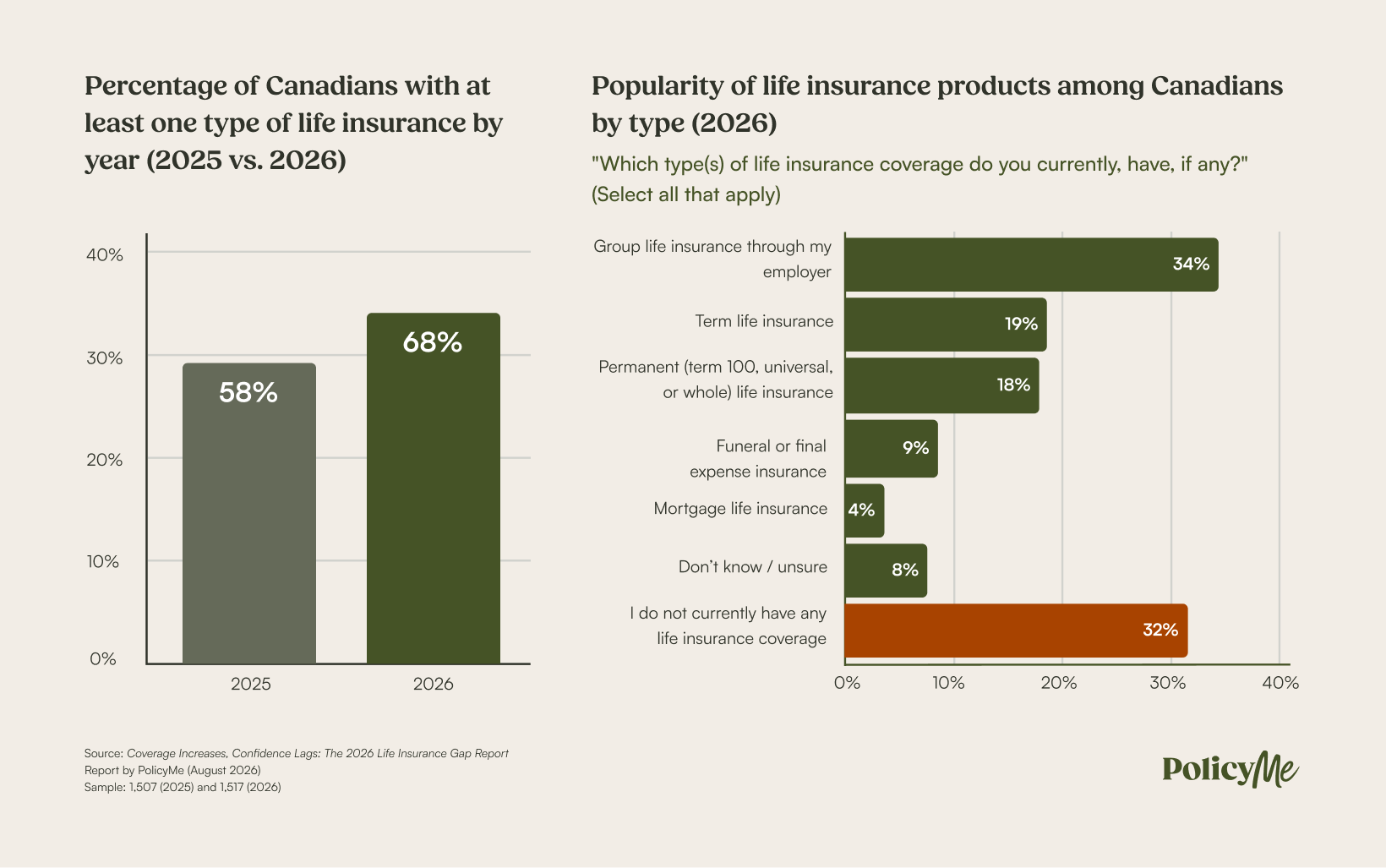
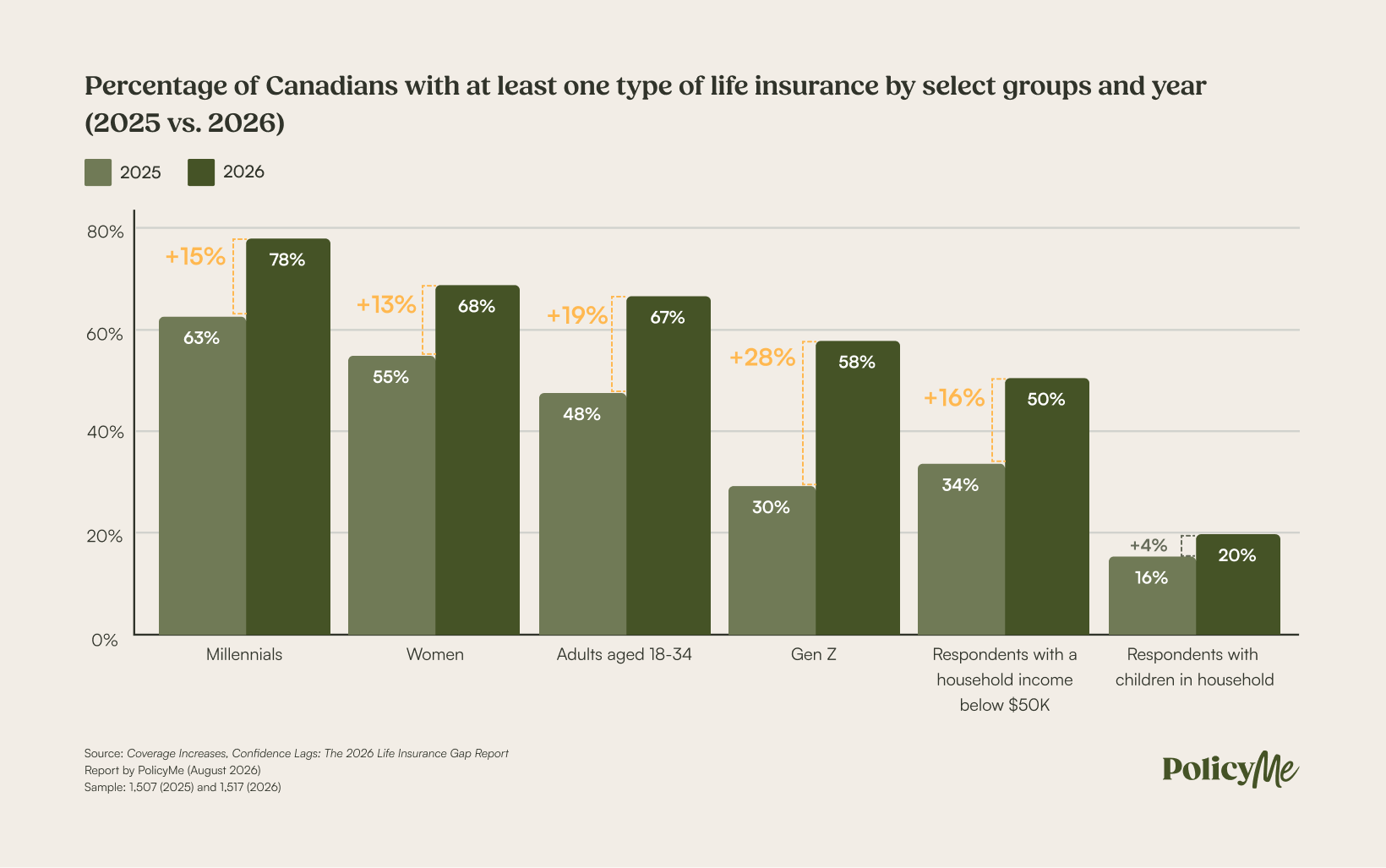
In 2026, roughly two in three Canadians (68%) had at least one type of life insurance, up 10 percentage points from 2025. Younger Canadians drove much of that growth: coverage among Canadians aged 18–34 rose from 48% to 67% year over year, while Gen Z coverage nearly doubled, from 30% to 58%. That jump likely tracks with more of this generation hitting milestones like buying their first home or starting a family.
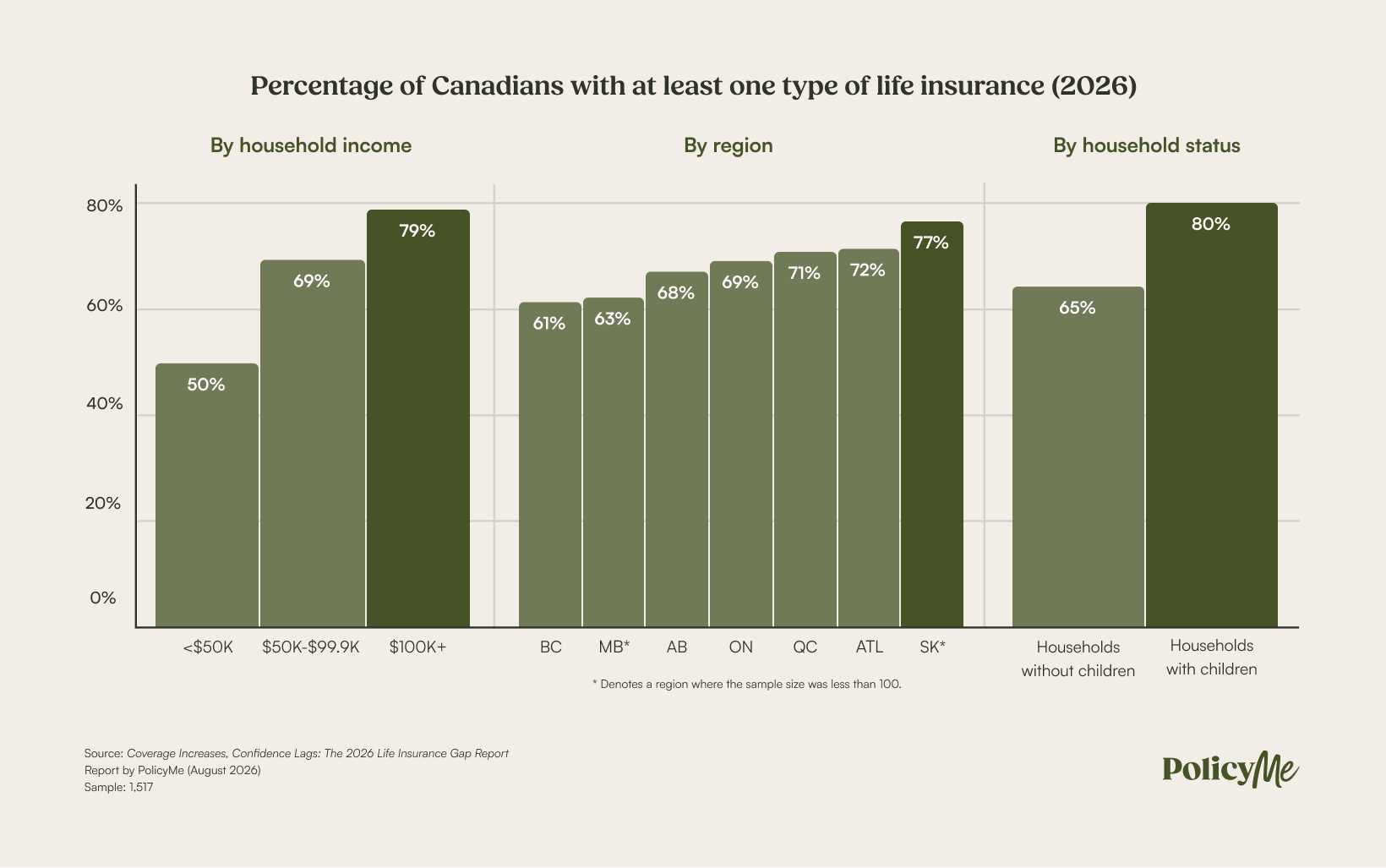
Coverage still isn’t evenly spread across the country. British Columbians had the lowest share of uninsured residents, with 39% of British Columbians carrying no life insurance coverage, compared to just 28% in the Atlantic region. B.C. also had the lowest percentage of workplace life insurance (25%), versus 34% nationally, a gap that may be contributing to the province lagging behind.
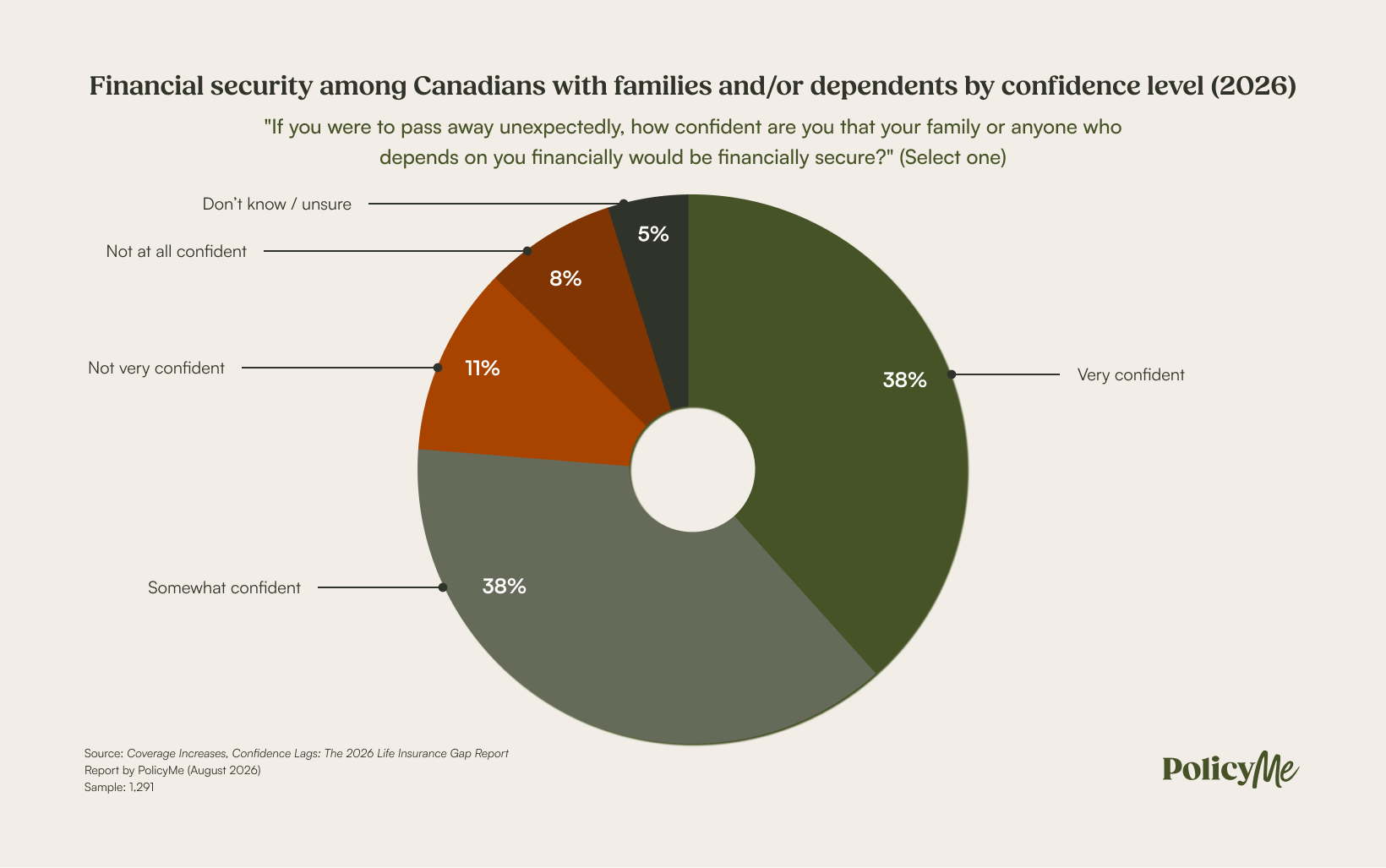
But having a policy and feeling secure about it aren't the same thing. Nearly 1 in 4 Canadians (24%) said they were either unsure or not confident that their families would be financially secure if they died unexpectedly. Some of that uncertainty likely traces back to how Canadians are getting covered in the first place: half of insured Canadians have workplace plans (50%), and more than a quarter don't even know how much coverage they actually have.
That gap in confidence shows up even more sharply for parents:
- In 2026, 20% of parents had no life insurance coverage, essentially unchanged from the 16% in 2025.
- 30% of parents weren’t confident or were unsure of their family’s financial security, a 9-percentage-point increase over those without children.
The findings suggest that although more Canadians had coverage in 2026 than in 2025, that growth didn't reach everyone equally. Parents, in particular, aren't gaining coverage at the same pace. This generally leaves households with kids more exposed, and less confident, than their childless counterparts.
What are the biggest barriers to getting life insurance?
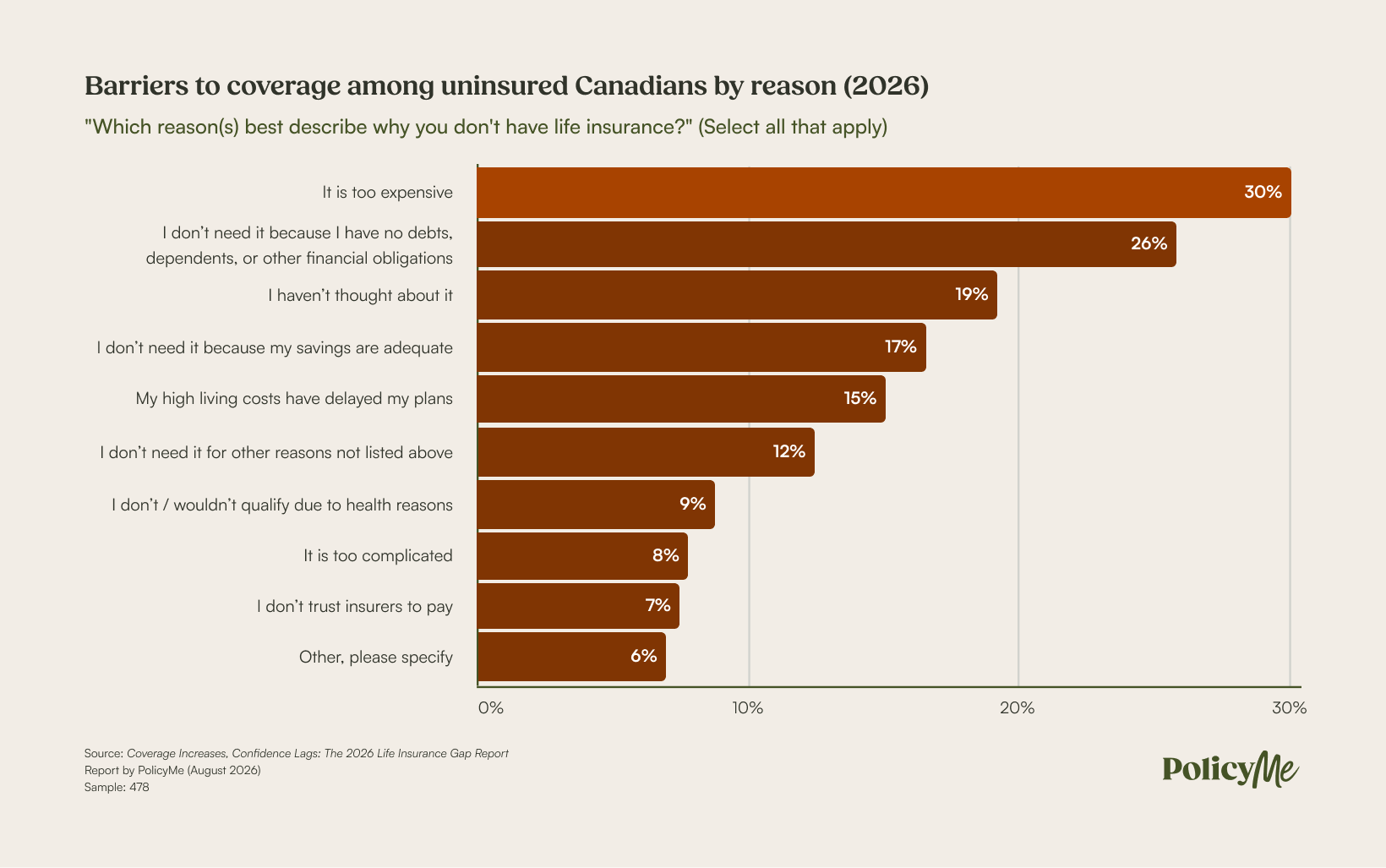
Affordability, or the perception of it, remains the number one reason Canadians go without coverage. Nearly 1 in 3 uninsured Canadians (30%) blamed their lack of coverage to cost, followed by not having much debts, dependents, or other financial obligations (26%), and simply not having thought about it (19%). And it's getting worse: 15% said rising living costs delayed their plans, up from 10% in 2025.
The “too expensive” mindset hits some groups harder than others:
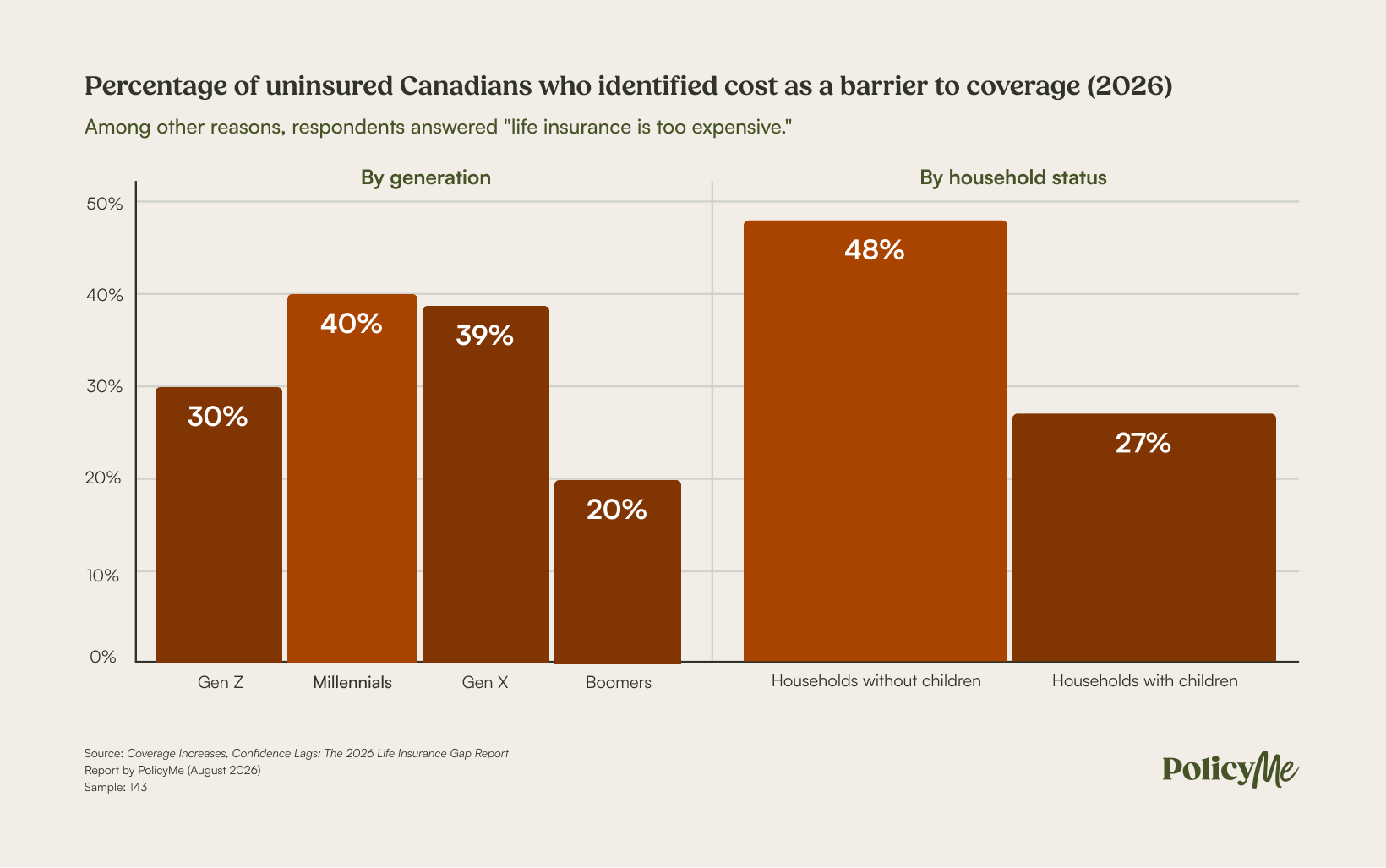
- 48% of parents cited cost as a reason for lack of coverage.
- Even as Gen Z drives this year's coverage gains, plenty haven't gotten there: 41% of Gen Z said they simply hadn’t thought about it, compared to just 5% of Boomers.
- 40% of uninsured Millennials and 39% of Gen X considered life insurance too pricey, nearly double the rate of Boomers (20%).
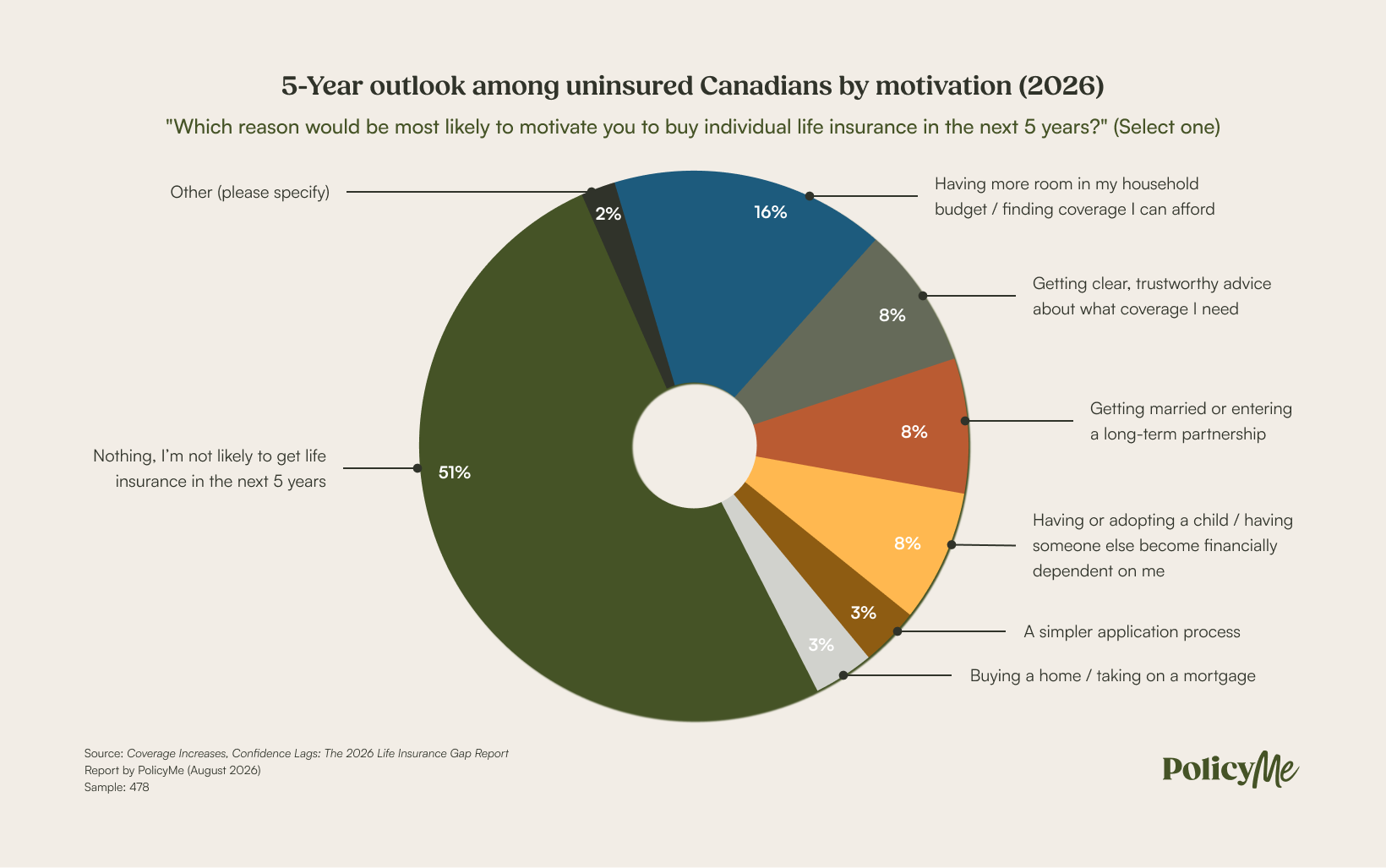
More than half of those uninsured (51%) said nothing would make them likely to purchase within the next five years, but 16% said they’d consider it with more room in the budget or for a more affordable price.
It’s worth noting that the affordability gap falls hardest on the households that can least afford it: nearly half of the Canadians who blame cost for their lack of coverage have children under 18 at home.
“Canadians with dependants, especially those with children in the household, are exactly who life insurance is designed to protect,” said Andrew Ostro, CEO and Co-Founder of PolicyMe. “That's a gap that needs to close, and awareness is a big part of it. Term life insurance is more affordable than most people think, it's just a matter of knowing that before cost becomes the reason to put it off.”
Is workplace life insurance coverage enough?
Workplace life insurance is a great starting point, but alone it’s rarely enough. Coverage can disappear the moment your job does, and the amount offered isn't likely to match what your family actually needs.
Among Canadians with life insurance, half (50%) said some form of their coverage came from a group plan at work.
Income appeared to play a role too: 79% of Canadians with an annual household income of $100K or more said they had life insurance, versus 50% of those with a household income of $49,999 or less.
Coverage amounts often fall short as well. The most common workplace coverage range was $100,000-$299,999 (26%), which can provide enough for a few years of income replacement, but likely not enough to raise young children to adulthood or pay off a mortgage.
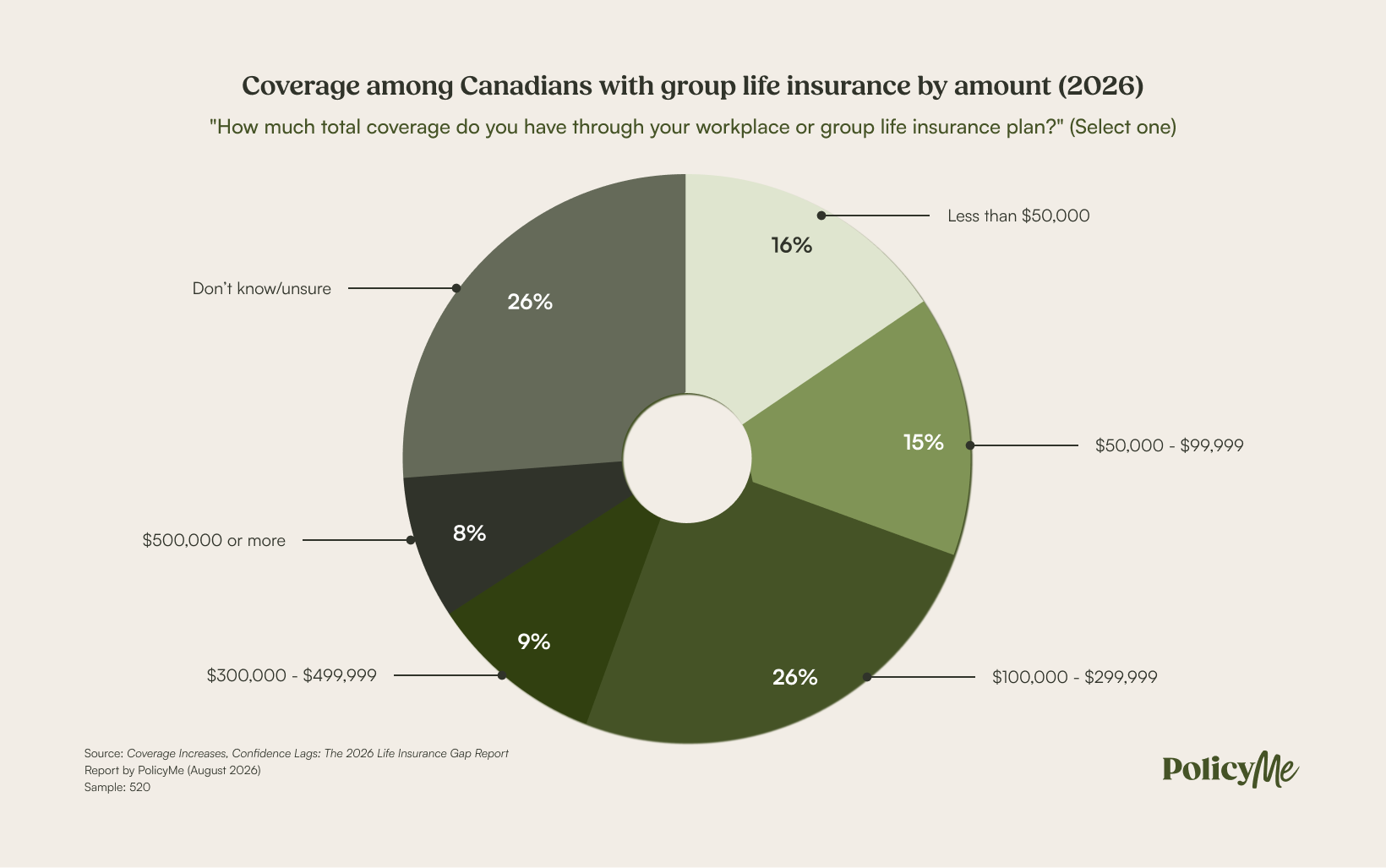
Another 26% of those with group life insurance weren’t sure how much coverage they actually had. That’s a hard place to plan from, you can’t assess whether your existing workplace coverage is enough if you don’t know the size of the policy.
When should you get life insurance?
Major life milestones, like a new baby or a first home, are powerful reasons people finally get covered. According to a separate internal data analysis conducted by PolicyMe, “family well-being” was a motivating factor for 79% of term life insurance seekers. 42% of customers cited a mortgage as a motivating factor.
But buying a home or starting a family isn't the only reason to think about coverage. If a partner, a business, or an aging parent depends on you financially, your responsibilities have already changed, whether or not a milestone marked the moment. It might be worth checking whether your current coverage (and savings) would actually cover what your family needs.
Bottom line: progress at the top, gaps below
More Canadians have life insurance today than they did a year ago. But according to the second edition of the Life Insurance Gap Report, significant gaps remain.
Nearly a third of the uninsured said cost was the main barrier. Younger Canadians and parents felt the cost squeeze the most, which is exactly backwards: they're the groups who'd benefit most from having coverage. If cost is what's holding you back, term life insurance is worth looking at first. It's typically the most affordable way to get meaningful protection, without a lot of the extra features (and price tag) that come with other policy types.
Workplace coverage was common, but so were low coverage amounts and confusion about how much protection these policies provided. Income made a real difference too: those earning over $100K per year were more likely to have both coverage and confidence, while lower-income households were more likely to have neither.
None of these gaps close on their own. For the families who need coverage most, waiting for a better moment usually just means staying exposed longer.
The good news: closing the gap doesn't take a milestone, a raise, or a five-year plan. It takes a few minutes.
Explore other PolicyMe data reports:
Jasmine specializes in converting complex insurance data into actionable guidance. Her background includes auto, life, and health insurance and financial planning. Lately, she’s leveraging AI to extract insights from the numbers and help Canadians make better decisions.
Jasmine specializes in converting complex insurance data into actionable guidance. Her background includes auto, life, and health insurance and financial planning. Lately, she’s leveraging AI to extract insights from the numbers and help Canadians make better decisions.