

Mortgage Insurance vs Life Insurance: Simple Guide


Term life insurance can give you the same protection as mortgage life insurance, with more flexibility and at a lower cost. Let’s get into the reasons why it’s a better choice for most Canadian families.
What is mortgage life insurance vs. life insurance?
Both policies (mortgage life insurance, aka mortgage protection insurance, and life insurance) can protect your spouse and kids if you pass away.
While mortgage life insurance pays the bank or lender directly, life insurance offers a tax-free lump sum to your beneficiaries (your family members) that can cover the mortgage and other expenses.
What is mortgage life insurance?
- Mortgage life insurance is an optional insurance policy for homeowners.
- You buy it through your bank or mortgage provider and it’s tied directly to your mortgage.
- Premiums for mortgage life insurance are based on your age and mortgage amount.
- Premiums are usually added to your monthly payments and stay level over time, even as your mortgage debt decreases.
If you pass away and there is still an outstanding balance on your mortgage, the provider will pay off the amount owing and your family will own the house outright.
What is term life insurance?
- Term life insurance is a type of policy you can buy through an insurance company.
- You choose how long you want your policy to last (typically 10, 20 or 30 years).
- You choose how much coverage you need, usually based on current and future financial obligations (debt, mortgage, cost of raising kids).
If you pass away, the life insurance company pays the coverage amount (also called the death benefit) to your beneficiary, which is usually your spouse or kids.
Watch the video below to learn about how term life insurance is different from mortgage life insurance.
Why many choose mortgage insurance (even if it’s not ideal)
The convenience of mortgage insurance is a major draw, but it’s not the only reason some people end up with this type of coverage:
- Convenience at the bank: Offered a policy at the same time you sign the mortgage loan.
- No medical exam: Approval is not dependent on medical approval.
- Rolled into mortgage payments: Money is withdrawn monthly alongside your mortgage.
But there’s a flip side to convenience: high costs, a diminishing payout structure, and limited flexibility with a mortgage insurance payout compared to a term life insurance policy.
Do I need mortgage insurance if I have life insurance?
You likely do not need mortgage life insurance or mortgage protection insurance if you already have life insurance in Canada. While it’s fine to hold both at once, for most people it’s unnecessary.

A term life insurance policy payout can cover your mortgage and provide greater flexibility, control, and overall tax-free value. Mortgage insurance skips your loved ones and pays the remaining mortgage balance directly to your lender.
Choose term life if:
- You want flexibility: Term payouts can cover more than just the mortgage (whatever your loved ones choose).
- You want stable coverage: Term payouts stay the same (don’t shrink) over time.
Consider mortgage insurance if:
- You can’t qualify for fully underwritten coverage: Mortgage insurance is easier to get, if health or lifestyle issues preclude you from regular term coverage.
- You need a quick, no-medical option: Fast coverage is your priority, and you don’t mind the cost tradeoff.
If you have term life insurance, you likely don’t need mortgage insurance on top of it. One well-structured life insurance policy can protect your mortgage and everything else that matters to your family. Speak to a financial advisor if you need help thinking through your financial situation.
How long do mortgage life insurance and life insurance last?
The length of your mortgage or life insurance policy depends either on the time left on your mortgage (mortgage insurance) or the set period you choose (term life insurance).
- Mortgage life insurance lasts as long as your outstanding mortgage debt. Once it’s paid off, or if you move to a different lender, the insurance policy ends.
- Term life insurance lasts as long as the policy length you choose. The timeline might be 10, 20, or 30 years, and you can choose a policy length that aligns with your amortization period.
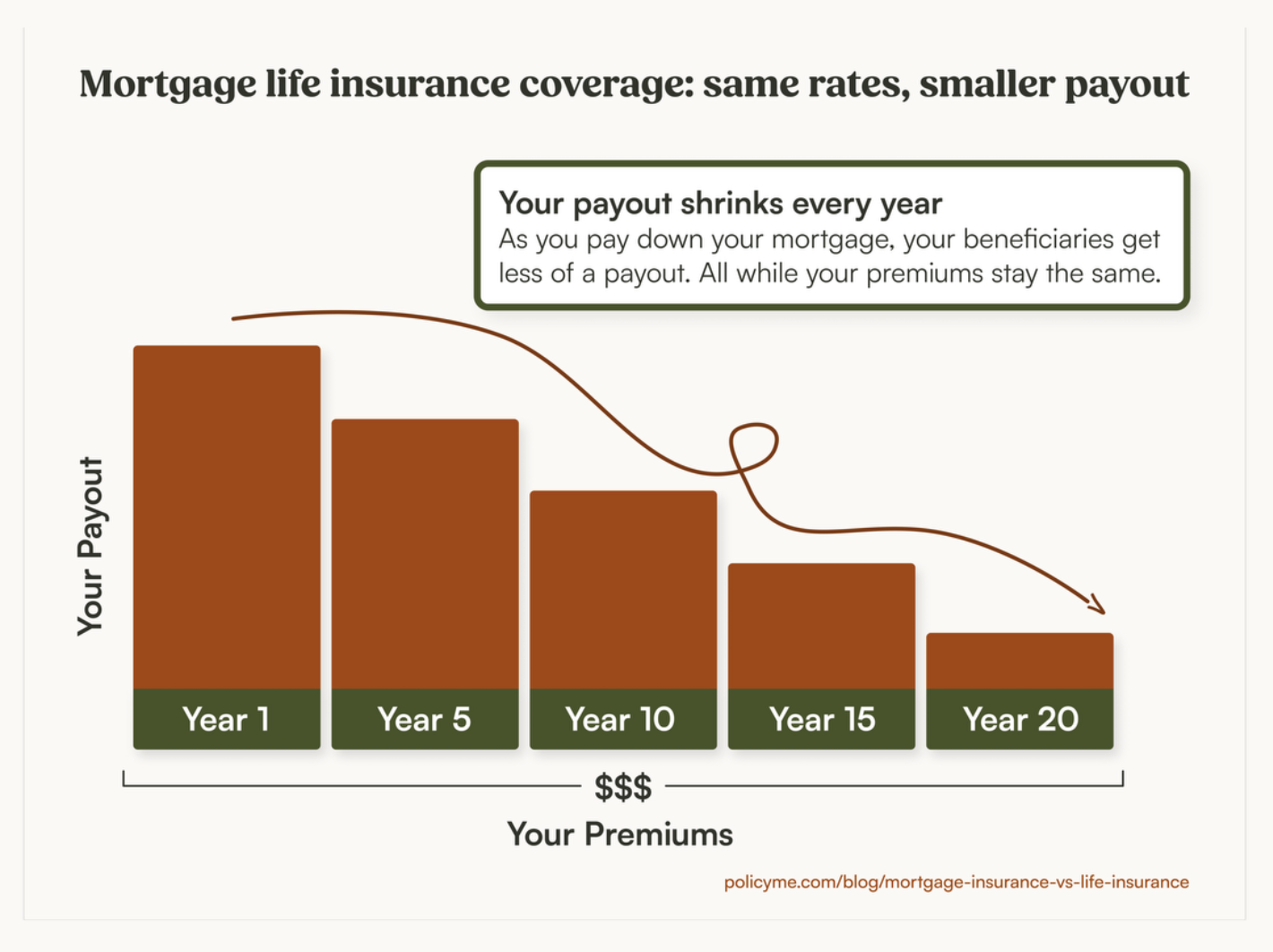
Importantly, there’s a big difference when it comes to the payout amount and the passing of time. Your mortgage insurance coverage (aka the payout amount) actually decreases as you pay down your mortgage over time, to match your remaining balance. With life insurance, the payout amount stays the same over time.
Some insurance providers will allow you to extend or convert your term life policy once your coverage period is complete. For example, if you have a 10-year policy and would like to extend to 20 years, this may be possible. Check with your insurer to confirm policy extendability.
What do mortgage life insurance and term life insurance cover?
Your mortgage can be covered either way, as both mortgage life insurance and term life insurance payouts can be used to cover your outstanding mortgage if you pass away. However, term life insurance can also cover additional expenses, and the death benefit payout goes directly to your beneficiaries, not to the bank or mortgage lender.
Let’s take a closer look at the coverage details for mortgage life insurance and term life insurance.
What mortgage life insurance covers
Mortgage life insurance can only be used to pay off your mortgage. As you pay off your mortgage, the death benefit decreases but your premiums stay the same.
Here are some key features of mortgage life insurance coverage:
- Benefit value: Your benefit amount from mortgage life insurance equals the remaining balance on your mortgage, so it decreases over time as you pay it off.
- Payout receiver: The payout will go to your mortgage lender, not to you or your family like with term life insurance.
- Transferability: Mortgage insurance is not transferable, as it’s linked to your specific mortgage. It can only be used to pay off the loan on that home. If you pay off the mortgage, switch lenders, or sell your home, the coverage will typically be cancelled.
“With mortgage life insurance, the death benefit is paid to the bank and your family doesn’t ever see the money.“ – Laura McKay, Certified Life Insurance Advisor and COO and co-founder of PolicyMe.
What term life insurance covers
Term life insurance payouts (death benefits) can be used for anything your beneficiaries choose: the balance on your mortgage, help with funeral expenses, private school or post-secondary education costs, medical costs, or a retirement fund for your spouse.
Term life insurance allows your family to use the money however they’d like. For example, they may choose to pay off the mortgage or use the money to pay for a child’s university tuition. It gives your family flexibility to use the money in the way that makes the most sense.
Ready to protect your mortgage and family? Start by looking at Canadian term life insurance plan options and rates. PolicyMe, which combines flexibility and affordability to make term life insurance accessible to Canadian families of all kinds. Get a no-obligation life insurance quote and start your application in a few clicks.
Cost of term life insurance vs mortgage insurance
In Canada, term life insurance is nearly always cheaper than mortgage insurance. In fact, mortgage life insurance premiums are usually more than double the amount you'd pay for term life insurance. Here are the main factors that affect the cost of mortgage insurance:
- Age: Like with most types of life insurance, the older you are, the more expensive your mortgage insurance premiums will be.
- Mortgage value: The more you owe, the more insurers will charge you for premiums.
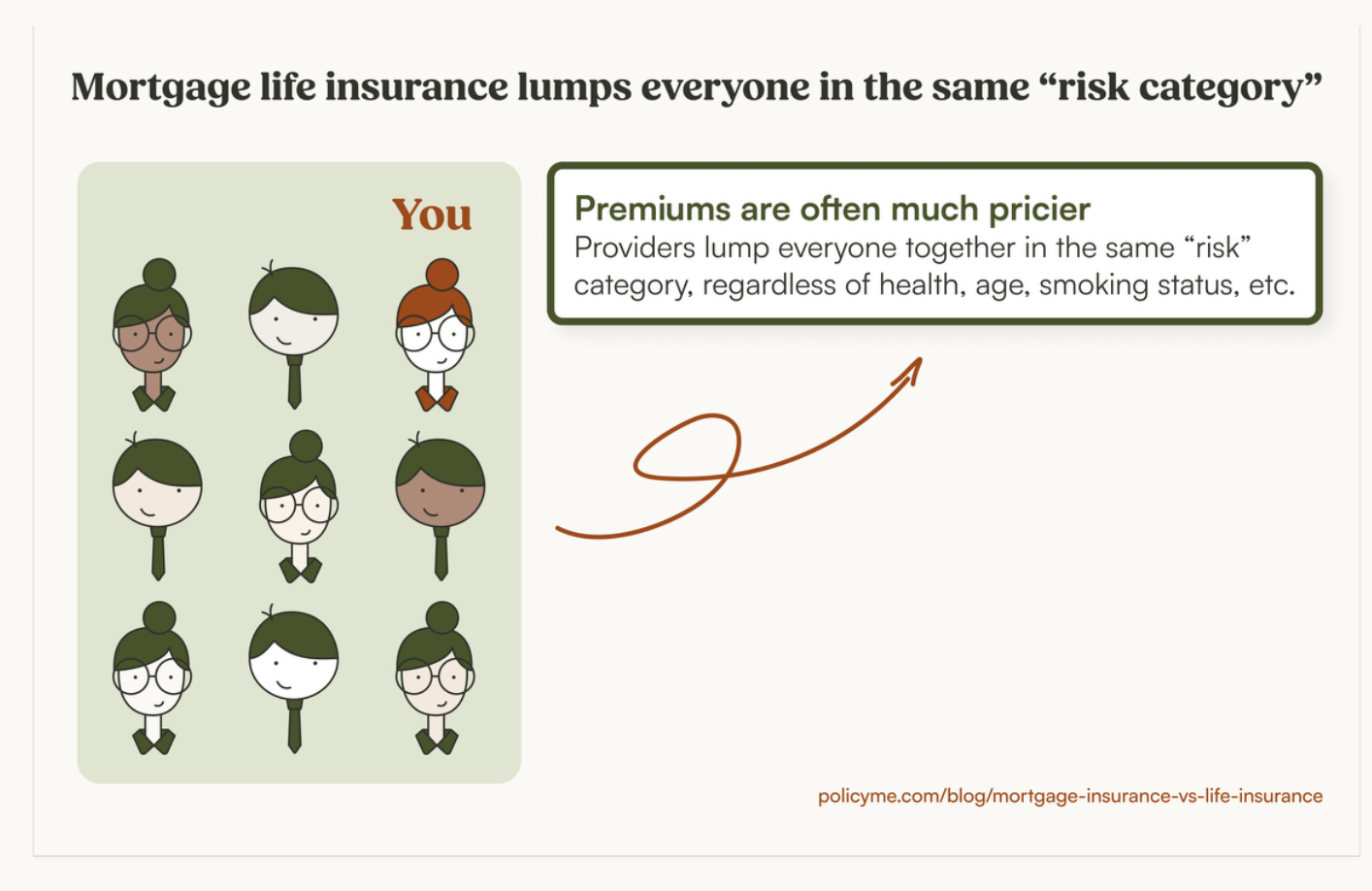
Another factor is that mortgage life insurance policies are not adjusted for individual risk. If you are a healthy person without high-risk hobbies, you will likely overpay for insurance if you choose a mortgage insurance policy.
Important note: Your mortgage insurance premiums stay the same, even as your mortgage balance shrinks. The payout decreases with every mortgage payment you make.
Here’s an example that compares average starting monthly premiums for term life and mortgage life insurance products, based on a 20-year, $500K policy for a 35-year-old non-smoking woman:
Bottom line: Averaging out the cost over 20 years for mortgage life insurance to $18,020.80, you’d save $12,097.60 over 20 years with term life insurance.
Do I need a medical exam for mortgage insurance?
No, medical exams are typically not required for mortgage insurance, making it a type of no medical insurance. You can expect a couple health-related questions, but no full exam.
The drawbacks to this approach? Cost and claim denial risk.
Mortgage insurance providers must assume everyone has the same risk (high) and so they set premiums high accordingly. Plus, underwriting happens after a claim is made, so mortgage insurers could deny a claim if you pass due to a pre-existing health issue.
When is mortgage insurance a good idea?
Mortgage insurance may sound like a good idea, but there are no typical circumstances in which this type of coverage is a flexible or affordable option to cover your family when compared to life insurance.
Here’s the truth: Homeowners do need some kind of protection, but your family would probably need more than a mortgage payoff if you pass away.
Achieve mortgage protection with better options like fully underwritten term coverage, or even simplified issue life insurance and guaranteed issue life insurance if you’re ineligible due to an existing health condition. Your insurance payout can be right-sized to fit your financial obligations, which can include your mortgage balance as well as debts and income replacement.
Good idea? Mortgage insurance can be a solution if you have specific concerns about paying off a property and you’re unsure that your beneficiaries would do so. But in most cases, it’s a better idea to choose another type of insurance and have a conversation with your heirs about your desires instead.
Bottom line: term life insurance makes sense for most Canadian families
Term life insurance is usually the smarter option over mortgage insurance if you’re looking for a policy that offers consistent coverage and real control over your financial legacy. It provides broader protection and puts the payout in the hands of your family members, not the bank.
Here’s a summary of why term life insurance stands out:
- You choose your beneficiary, so your loved ones receive the payout, not your lender.
- The coverage isn’t limited to your mortgage; it can be used for anything from debt repayment to funeral costs, helping your partner maintain their lifestyle.
- Premiums remain fixed for the length of your term (often 20 or 30 years), while mortgage insurance premiums reset and increase each time you renew your mortgage.
- Since it’s not tied to your lender, coverage continues even if you refinance or switch mortgage providers.
- The death benefit never decreases, so your beneficiaries will receive the full payout regardless of when a claim is made.
Start by applying for term life insurance. With PolicyMe, the online application is just 20 minutes to complete a 26-question form. Most applicants don’t need a medical exam, and you’ll get an instant decision: approved, declined, or flagged for follow-up if more info is needed (like a doctor’s note or nurse visit).
FAQ: Life insurance vs mortgage insurance in Canada
*Life insurance rates in this article are based on publicly available premiums.
Jaya is a researcher and writer with 3 years of experience in insurance and finance. She writes in-depth content that bridges technical expertise with accessible insights. Her work spans topics such as life insurance, health and dental coverage, car insurance, and financial literacy, helping Canadians make informed decisions about their financial protection. With a background in market research and editorial strategy, she collaborates closely with subject matter experts to ensure accuracy, clarity, and value in every piece.
Jaya is a researcher and writer with 3 years of experience in insurance and finance. She writes in-depth content that bridges technical expertise with accessible insights. Her work spans topics such as life insurance, health and dental coverage, car insurance, and financial literacy, helping Canadians make informed decisions about their financial protection. With a background in market research and editorial strategy, she collaborates closely with subject matter experts to ensure accuracy, clarity, and value in every piece.