

Critical Illness Insurance Quotes in Canada


Critical illness insurance provides a one-time lump-sum payout if you’re diagnosed with a life-threatening covered condition such as cancer, heart attack, or stroke.
Payouts from critical illness insurance can be as high as $1 million or more, though the average coverage amount in Canada is much lower: typically $50,000 to $100,000.
Compare quotes for 20-year critical illness insurance: Women
* Values above represent PolicyMe monthly premiums for a non-smoking woman as of September 2026.
Compare quotes for 20-year critical illness insurance: Men
* Values above represent PolicyMe monthly premiums for a non-smoking man as of September 2026.
What does PolicyMe critical illness insurance cover?
PolicyMe’s critical illness insurance product offers full or partial coverage for 44 distinct conditions, more than most insurers in Canada.

Your policy offers full and partial payouts, depending on the condition. For example, you may receive a percentage of your policy’s value for early-stage diseases and less severe diagnoses. PolicyMe covers 17 early-stage conditions like early-stage prostate cancer and ablation surgeries. In the case of an early partial payout, your policy stays active in the future.
If you’re diagnosed with a covered critical illness that qualifies for a payout, you can use your critical illness insurance payment however you choose: medical expenses, home care, childcare while you recover, or lifestyle changes your condition requires.
This is a list of the conditions that PolicyMe’s critical illness insurance covers:
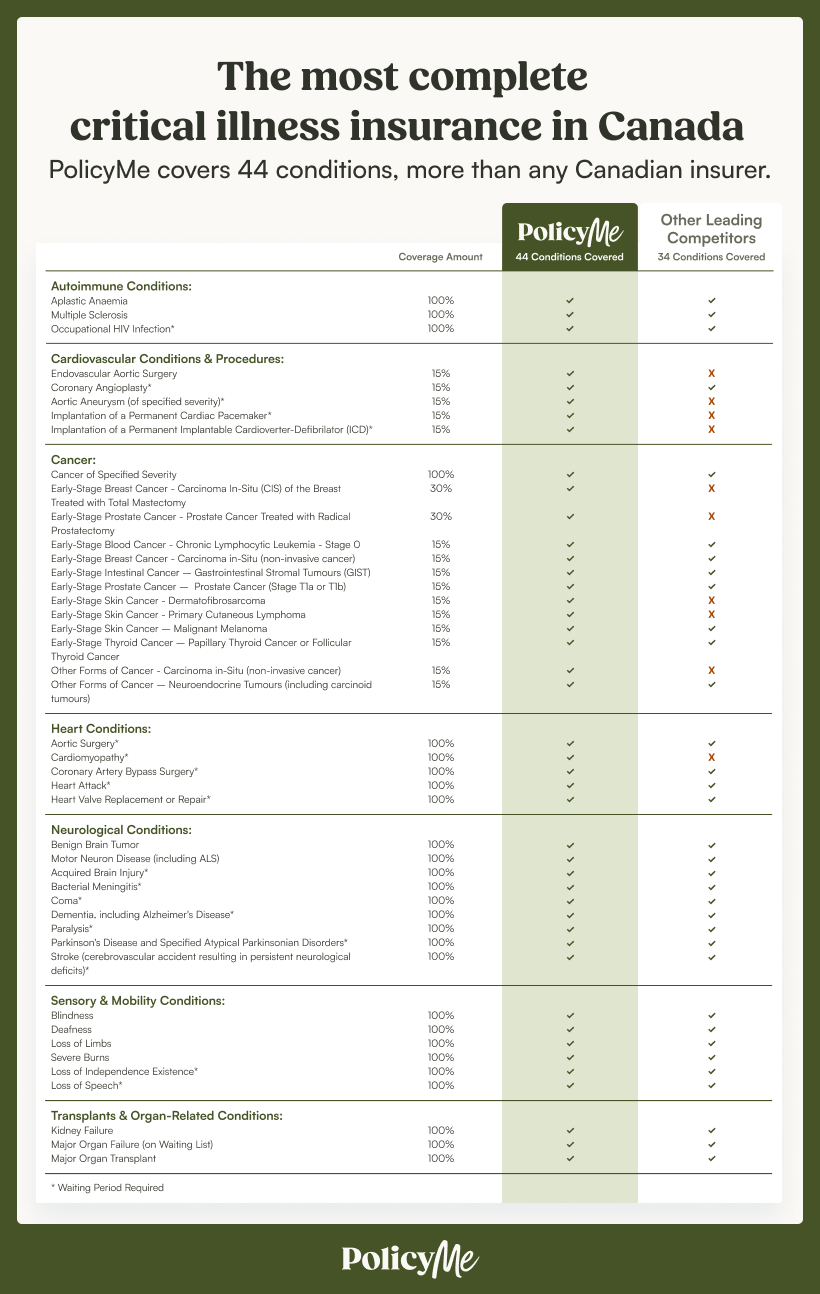
Coverage may be especially relevant to the specific health risks you face based on your sex and age:
- Men: Heart disease and prostate cancer are most common.
- Women: Breast cancer is the most common.
- Seniors: Stroke and cancer risk rise substantially with age.
Risks by sex: It’s estimated that about 23% of new male cancer cases in 2026 are prostate cancer, and 26% of new female cancer cases are breast cancer, according to the Canadian Cancer Society. Men also have a higher mortality rate.
Risks by age: Age is another major risk factor, independent from family history. The same report indicates that 9 in 10 cancer cases in Canada are diagnosed in people over age 50. This is a prime earning period for many Canadians, so a serious illness at this age could devastate your finances.
How much critical illness coverage do you need?
Critical illness insurance policies typically offer benefit amounts as low as $10,000 or as high as $1–3 million. Payouts are tax-free.
- Choose a smaller critical illness benefit if you have decent emergency savings and just want a small financial boost to help your family through a rough patch.
- Choose a higher coverage amount if you don’t have a large financial security net and want peace of mind for your loved ones in the event of a major diagnosis.
Your critical illness insurance plan should include enough coverage to meet your realistic anticipated needs in the event of a serious illness. Think about:
- Lost income: How much do you make and how would it impact your family if you were temporarily unable to work due to illness?
- Medical expenses: How much healthcare coverage do you have through your province, workplace, and/or private plans?
- Childcare: If you have children, would a serious illness interrupt your ability to care for your dependents?
- Your savings: How big is your “rainy day fund”? How much financial breathing room would you have in the event of a major life event that introduced new expenses?
Disability insurance can also help out if you’re diagnosed with a serious illness that requires you to take time off work.
- Disability insurance covers a wider range of conditions and provides partial income replacement on an ongoing basis.
- Critical illness insurance applies to a smaller list of serious medical conditions and offers a one-time lump-sum payment that can be used to cover any costs you have.
Both disability insurance and critical illness insurance are common workplace benefits. If you already have disability insurance, consider whether a critical illness insurance policy could supplement the income replacement you’re eligible for through disability insurance.
How to choose a critical illness term length
Critical illness insurance coverage is typically available in 10-, 20-, or 30-year terms. Coverage is usually available up to age 70.
- Choose a shorter term if your priority is financial support while your children are young or if you’re still working to pay off debts and build financial stability.
- Choose a longer term if you want to maintain financial protection across your adult years.
When choosing your critical illness insurance term, you might be offered a feature called a return of premium (ROP) rider. This add-on promises to pay back all of the premiums you paid at the end of your policy term if you never received a payout.
While potentially beneficial in the long run, a ROP rider will significantly inflate your critical illness insurance quotes and cost you more across the life of the policy. This will reduce the overall benefit you can afford and will make maintaining CI coverage a bigger financial hurdle.
3 things that impact the cost of your critical illness insurance
Critical illness insurance quotes take into account your overall risk of developing a critical illness based on statistical rates of disease.
- Your age: Age greatly impacts the risk of various critical illnesses, including stroke, heart disease, and cancer. The earlier in life you buy critical illness insurance, the better your odds of finding affordable quotes.
- Your overall health and family medical history: If you have certain pre-existing conditions, such as heart disease or neurological disorders, you may pay more for critical illness insurance or even be ineligible for coverage.
- Your benefit amount: The larger your policy, the more you’ll pay to maintain it.
No, you typically don’t need a medical exam for critical illness insurance. Your quotes and eligibility for coverage will be determined by a medical questionnaire that screens for major pre-existing conditions and other risk factors.
How to get a critical illness insurance quote (and apply)
It’s easy to apply for a critical illness insurance policy in Canada, with online quotes and fast application processes. Quotes can be instantly generated, although full approval after application may take several days or several weeks depending on the provider and the applicant’s health history.
You can get a critical illness quote almost instantly by submitting basic information, such as your age, sex, smoking status, and desired coverage amount. But a quote does not guarantee you will qualify. When you’re ready to actually apply, expect to submit more health information and wait a little longer.
Steps to get a quote for critical illness insurance:
- Find several providers that offer online quotes
- Submit basic personal details (age, sex, smoking status)
- Submit basic policy details (desired coverage amount and term)
- Receive your estimates and compare offers
Steps to apply for critical illness insurance:
- Confirm policy details (coverage amount, term, and covered illnesses)
- Submit additional health information
- Await underwriting and final policy estimate
- Pay your first premium and your coverage begins
Is critical illness insurance worth it?
A growing number of Canadian households have little to no emergency savings, with nearly 50% reporting in 2025 that their savings wouldn’t cover three months of living expenses.
If your family is among the thousands of Canadian households with limited emergency savings, critical illness insurance may be worth it.
Critical and chronic illnesses are on the rise in Canada, with younger Canadians facing major diagnoses like colorectal cancer, heart disease, and stroke. A financial plan that accounts for unexpected major illness can provide superior long-term financial security and peace of mind.
- The Canadian Cancer Society estimates that 696 Canadians will be diagnosed with cancer every single day in 2026.
- Since 2019, over 700,000 Canadians have experienced heart attacks each year.
- One in four Canadians living with stroke is under age 65.
FAQ: Critical illness insurance quotes
R.E. specializes in making insurance accessible through clear, actionable content backed by data and created for ordinary Canadians. They have 10 years of experience in digital content creation, including 4 years of focused work in the insurance space. A published author with a background in finance journalism, R.E. earned a personal lines insurance license in 2024 to expand their ability to break down complex insurance topics for the consumers who need most to understand them.
- 10 years of experience
- Expertise: life insurance, health and dental insurance, auto insurance, home insurance, personal finance, finance journalism
- Education: Bachelor of Science, Clarkson University; Master of Arts, University of Rochester
R.E. specializes in making insurance accessible through clear, actionable content backed by data and created for ordinary Canadians. They have 10 years of experience in digital content creation, including 4 years of focused work in the insurance space. A published author with a background in finance journalism, R.E. earned a personal lines insurance license in 2024 to expand their ability to break down complex insurance topics for the consumers who need most to understand them.
- 10 years of experience
- Expertise: life insurance, health and dental insurance, auto insurance, home insurance, personal finance, finance journalism
- Education: Bachelor of Science, Clarkson University; Master of Arts, University of Rochester